


Migrating to SAP S/4HANA TM is a key milestone—but it doesn’t automatically eliminate manual effort. Many organizations still rely on spreadsheets, manual freight creation, and constant coordination with carriers even after go-live.
The real value of SAP S/4HANA TM lies in process automation. By automating transportation planning and execution, organizations can reduce manual effort, improve planning accuracy, increase operational visibility, and enable transportation teams to focus on exceptions rather than routine tasks.
This blog explores how key automation capabilities in SAP S/4HANA TM help organizations build more efficient, scalable, and intelligent transportation operations.
In SAP TM 9.x, master data is replicated between decentralised systems using CIF, which often introduces delays, inconsistencies, and additional operational overhead.
In contrast, SAP S/4HANA Embedded TM operates on a unified data model with real-time access—removing the need for replication and enabling faster, more consistent, and reliable transportation processes.
In SAP TM 9.x, Freight Units are generated through multiple layers (OTR/DTR), with data transferred from ERP to TM—resulting in a more complex and time-consuming process.
This approach increases manual effort, introduces data duplication, and requires continuous monitoring of queues for error handling.
In contrast, SAP S/4HANA Embedded TM creates Freight Units directly from business documents within the same system, eliminating intermediate steps.
This enables real-time processing, simplifies error handling, and improves overall planning efficiency.
In SAP TM 9.x, sales order scheduling is primarily ERP-driven using LE-TRA routes and basic logic, with TM involvement only after order transfer. Combined with dual master data maintenance (LE-TRA routes and TM lanes), this often results in approximate delivery dates and manual adjustments.
In contrast, S/4HANA TM enables TM-driven scheduling using default routes, transportation lanes, and real-time logic—eliminating duplicate maintenance while improving delivery date accuracy, simplifying master data management, and strengthening ATP integration with reduced manual effort.
Note:
TM-driven sales order scheduling is available starting from SAP S/4HANA 2023 FPS1.
In SAP TM 9.x, TM–EWM integration is based on Transportation Units (TU) with asynchronous message exchange and manual triggers—often leading to delays and higher interface complexity. This approach can introduce data duplication, limited flexibility, and increased effort in monitoring and error handling.
In contrast, S/4HANA TM enables real-time integration through ASR using Freight Orders—removing TU dependency and ensuring tight synchronization between systems. This results in a simplified architecture, reduced duplication, and improved flexibility, visibility, and execution efficiency.
SAP TM 9.x relies on replicated data and external tools, leading to delayed analytics that are primarily focused on historical insights.
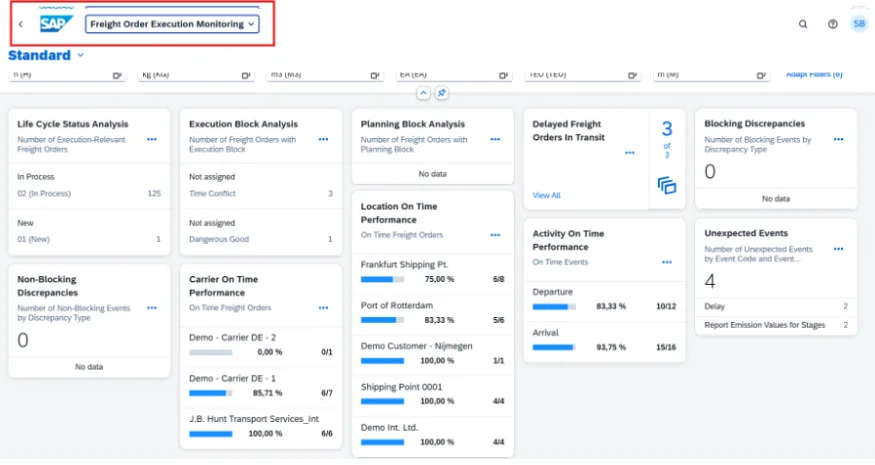
In contrast, S/4HANA TM delivers embedded analytics with real-time, interactive dashboards on live data—enabling instant insights, proactive decisions, and better operational control.
The “No-Click” (fully automated) scenario in SAP S/4HANA TM enables end-to-end transportation execution through background processing and tightly integrated workflows.
Core activities—planning, carrier selection, freight order creation, scheduling, and charge calculation—are executed automatically, with user involvement limited to exceptions, urgent shipments, or troubleshooting.
This approach accelerates processing, reduces manual effort and errors, ensures consistent rule-based decisions, and scales efficiently to handle high shipment volumes.
S/4HANA introduces Automated Freight Order Planning with Requirement Grouping, which enables rule-based consolidation of Freight Units (FUs) into Freight Orders (FOs), reducing dependency on the traditional VSR optimizer. Based on configurable grouping criteria such as locations, time windows, shipping conditions, and transport modes, the system intelligently clusters compatible Freight Units and generates capacity-efficient Freight Orders.This approach helps reduce planning complexity and master data dependency while improving automation, enabling both background execution and real-time monitoring through the TM cockpit, thereby enhancing overall planning efficiency and scalability.
Predictive Alerts in SAP S/4HANA TM help shift transportation management from reacting to issues to anticipating them in advance. By combining machine learning with real-time shipment data, the system can flag potential delays, capacity bottlenecks, and risks like spoilage or route deviations before they impact execution. Instead of relying only on static rules, it learns from historical trends and live transport events, and presents insights directly in SAP Fiori apps such as the Transportation Cockpit. Integration with the SAP Business Network for Logistics further improves visibility across carriers and enhances prediction accuracy.
Overall, it enables earlier action, fewer surprises, and more reliable transportation execution.
In TM 9.x, Packaging and load planning are handled in a more rule-driven and partially manual way. Optimization is limited, and planners often need to adjust pallet building and truck loading separately with minimal system guidance.
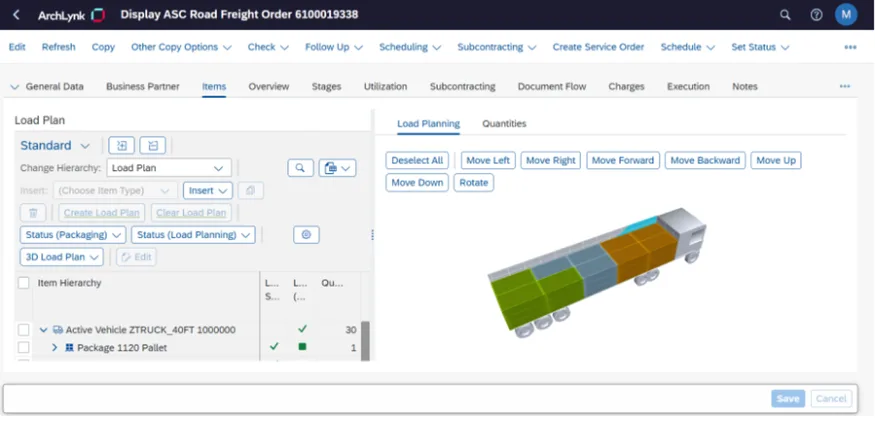
S/4HANA TM brings a more connected and intelligent approach, where packaging and load planning operate as a single, integrated flow. The system automatically builds stable pallets and optimally positions them within vehicles, considering real-world constraints such as space availability, weight distribution, and delivery sequence. With built-in visual support and automated validations, planners can quickly review and adjust loading decisions, resulting in improved vehicle utilisation, fewer errors, and smoother execution.
Migrating to SAP S/4HANA TM is more than a technology upgrade—it is an opportunity to transform how transportation operations are planned, executed, and managed. While migration establishes the foundation, the greatest value comes from leveraging automation to reduce manual effort, improve planning accuracy, increase operational visibility, and enable exception-based management across the transportation lifecycle.
As supply chains continue to grow in complexity, organizations that embrace intelligent transportation automation will be better positioned to improve service levels, increase operational efficiency, and scale their logistics operations with greater confidence.
Planning your migration from SAP TM 9.x to SAP S/4HANA TM? Connect with an ArchLynk expert to learn how we can help you accelerate your transportation transformation and unlock the full business value of SAP S/4HANA TM.