


Every shipment has a destination, but reaching the dock at the right time is often more challenging than the journey itself.
Ask anyone who runs a distribution center what their most stressful hour of the day is, and most will point to the yard. Trucks queued outside the gate, dispatchers on the phone chasing ETAs, dock doors sitting empty while three carriers show up at once for the same slot.
As supply chain operations become faster, larger, and more interconnected, dock appointment scheduling has evolved from a simple calendar booking into a critical function. Unplanned arrivals, limited dock capacities, carrier delays, warehouse congestion, and poor coordination can quickly disrupt the entire logistics network, resulting in increased costs.
Managing dock appointments has grown complex as networks scale. Legacy operations still depend on high manual effort, using phone calls, spreadsheets, emails and whiteboards to book and track appointments. Because scheduling is decentralized across sites, there is no unified view of dock capacity, and volume quickly becomes unmanageable as more carriers and locations are added. This also forces planners into dual work: managing the shipment in S/4HANA while separately tracking the same shipment's dock appointment in a disconnected process, with no link between the two systems.
The underlying gap of decentralisation played out in a very specific way for one of the ArchLynk’s customers. Appointments were booked manually in legacy system and communicated to carriers over email and chat. If a slot needed to change, the only option was to notify the carrier the same way, offline and outside the system.
This offline dependency meant every appointment change added another round of calls and messages, with no system tracking how long it took or how often it happened. A missed message or a delayed reply could mean a carrier arriving at the wrong time, or not knowing a slot had changed at all. Coordinators spent as much time chasing confirmations as they did schedule, and none of that effort was visible anywhere in S/4HANA TM.
Over time, the true cost of managing dock bookings, including coordinator hours, the back and forth, and carrier wait time at the gate, stayed invisible, because nothing in the process measured it. Leadership had no way to quantify what inefficient scheduling was costing the business.
What the customer needed wasn't a better spreadsheet or a faster inbox; it was appointment scheduling centralized within S/4HANA TM, where the freight order and the dock booking finally shared one system.
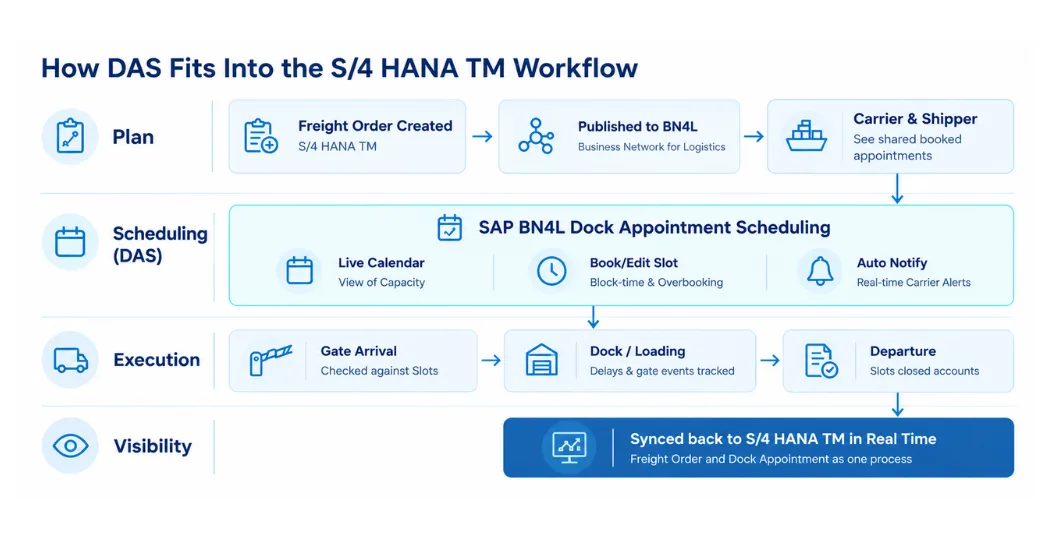
With the case for centralization clear, the customer was introduced to SAP BN4L Dock Appointment Scheduling, built natively into S/4HANA TM-BN4L. A calendar view replaced the offline booking process, giving coordinators a live picture of dock capacity, while block-time and overbooking features let sites manage peak periods and no-shows deliberately rather than reactively. Appointments could now be edited or modified directly in the system, closing the gap that once required an offline call or message for every change. Real-time notifications kept carriers informed automatically, and monitoring of loading, delay, and gate events meant the wait time that used to go unmeasured was now visible and actionable. Every one of these events synced back to S/4HANA TM in real time, finally linking the freight order and the dock appointment as one process.
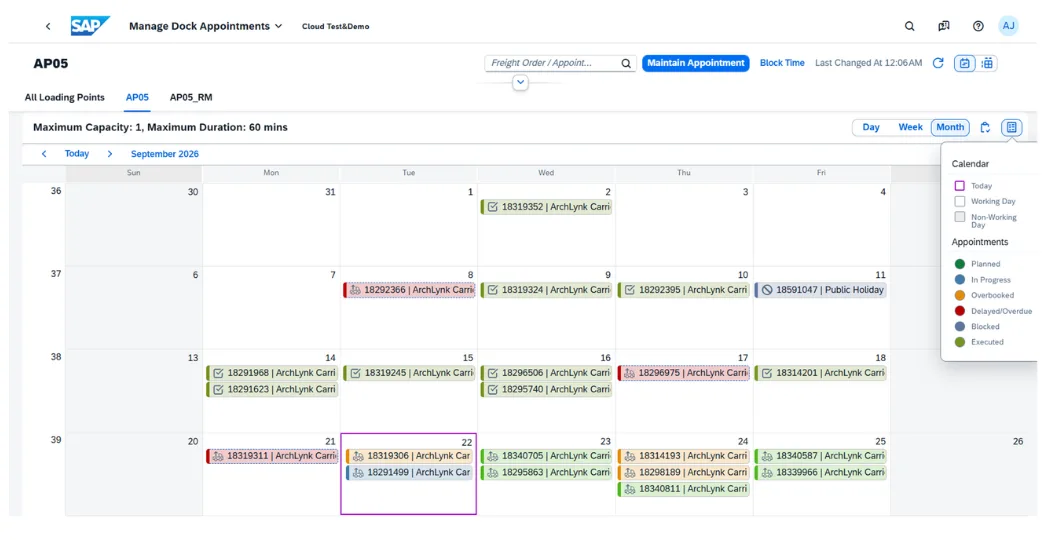
The rollout began with three pilot dock locations going live to observe how these features performed under real conditions. In the first month, the appointments for all freight orders at these three sites were scheduled using DAS, accounting for 30% of overall freight orders in the TMS. By month two, two additional dock locations came online, pushing DAS-scheduled freight orders to 50%. By month three, every dock location was live on DAS, with 100% of dock shipments handled through the system, freeing up dock availability and driving a more optimized, centralized operation.
DAS isn't a fit for every operation on day one, but a few signals tend to mean it's time to look seriously at it. If dock scheduling still runs on phone calls, emails, or spreadsheets, and it's starting to break down as carrier volume grows, that's a strong signal. If detention costs, idle dock time, or unplanned warehouse overtime keep showing up as a recurring cost nobody can quite pin down, that's another. If your team already runs SAP EWM or TM and wants dock scheduling connected to that environment instead of sitting on the side, DAS fits naturally. And if you're coordinating multiple carriers and shippers across shared loading points, and everyone involved needs the same real-time view of the schedule, that collaborative model is exactly what DAS was built for.
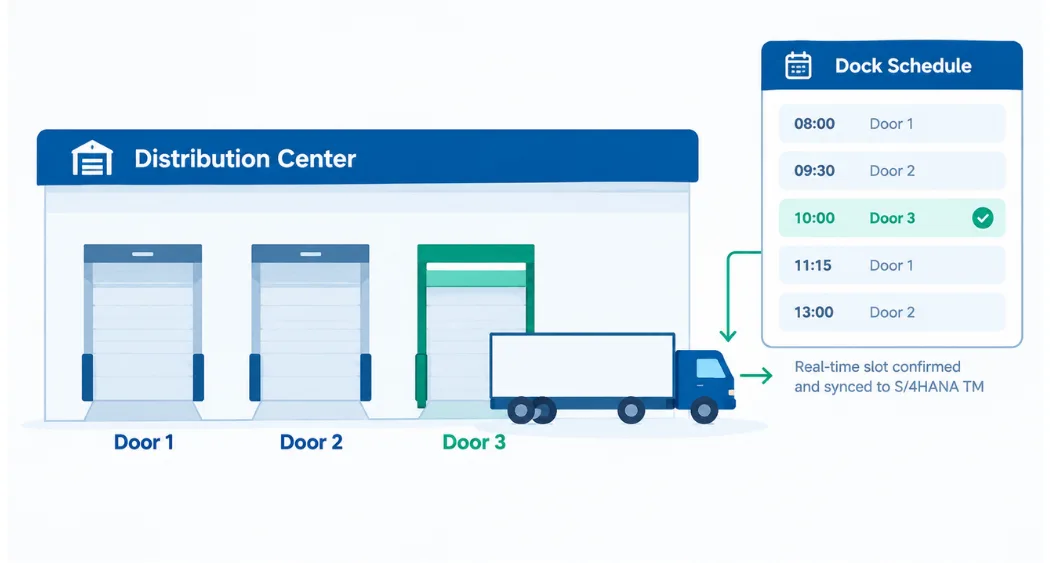
The right time to bring DAS into an S/4HANA TM landscape depends on where the organization is starting from:
Greenfield implementation:
If the organization is implementing S/4HANA TM from scratch and expects a high volume of appointment creation across its network, it is worth selecting the SAP Logistics Business Network (BN4L) package with DAS included from day one. Building the appointment process on DAS natively avoids a second migration later and lets carrier onboarding and TM go live together.
Brownfield implementation:
If the organization already runs S/4HANA TM, the lower-friction path is to move TM to the S/4HANA 2024 package and then switch on DAS services incrementally, site by site, as each dock location is ready to go live, mirroring the phased pilot-then-scale approach described above. This lets a brownfield customer de-risk the rollout without waiting for every site to be ready at once.
Whichever path fits, the underlying case for DAS is the same: it removes the manual, offline, and invisible parts of appointment scheduling and replaces them with a calendar-driven, real-time process that keeps the dock and S/4HANA TM in sync.
Dock operations rarely get attention until something breaks: a missed appointment, an idle dock, an angry carrier. Often the bigger problem is not the docks themselves but the lack of a unified view of dock capacity. The answer is giving shippers, carriers, and warehouse teams the same real-time view of the dock, and letting the workflow run on that shared view instead of a phone call.
At ArchLynk, we implement SAP BN4L Dock Appointment Scheduling as part of the wider SAP logistics landscape, integrated with S/4HANA TM. For this customer, that meant three pilot dock locations live in month one and 100% of dock shipments scheduled through DAS by month three. If your dock still runs on spreadsheets and phone calls, it may be time to look at what DAS could do for your sites.