


Confirming a realistic delivery date during sales order entry is a basic expectation in many order‑to‑cash processes. Customers depend on this date to plan production, pickups, and downstream activities, so any later changes quickly create operational friction.
Historically, sales order scheduling in SAP ERP relied on route-based scheduling using LE-TRA master data. When SAP TM was used as an external system (for example TM 9.5 or 9.6), sales orders could call TM synchronously to get transport‑aware dates. This helped incorporate real transportation constraints—such as resource availability or carrier schedules—that classic route-based logic simply couldn’t consider. This made delivery date confirmation significantly more realistic compared to classic ERP scheduling.
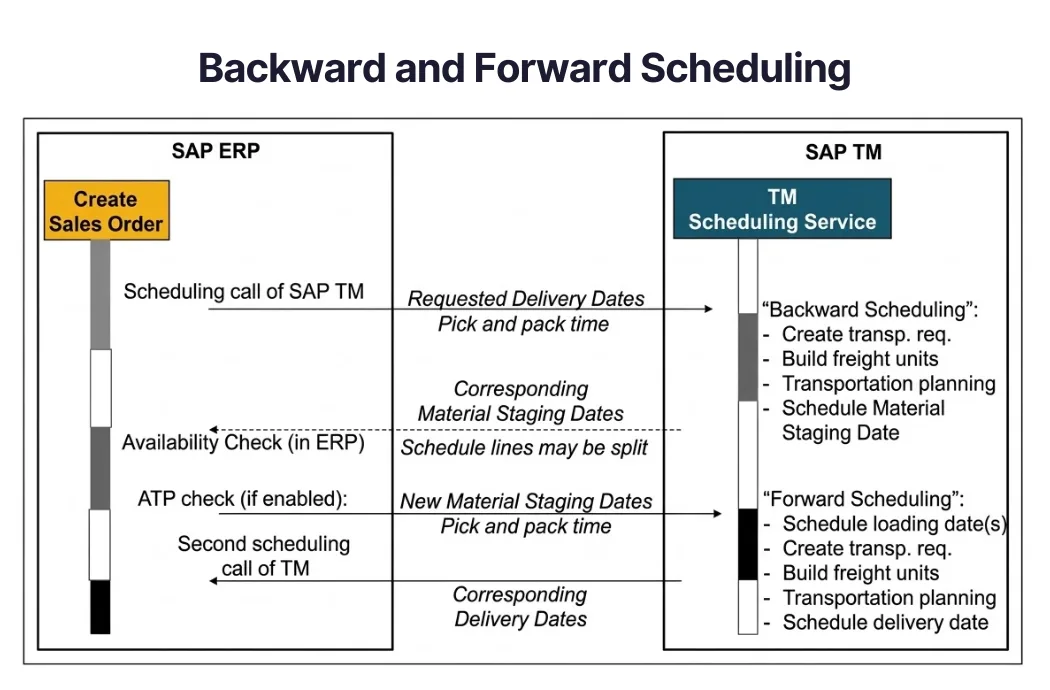
With the move to embedded SAP TM in S/4HANA, TM‑based sales order scheduling was initially unavailable. Customers therefore continued using route‑based LE‑TRA scheduling, while TM recalculated dates during freight unit planning, at times creating inconsistencies. Master data also had to be maintained separately for SD scheduling and TM planning, leading to redundancy and misaligned delivery dates.
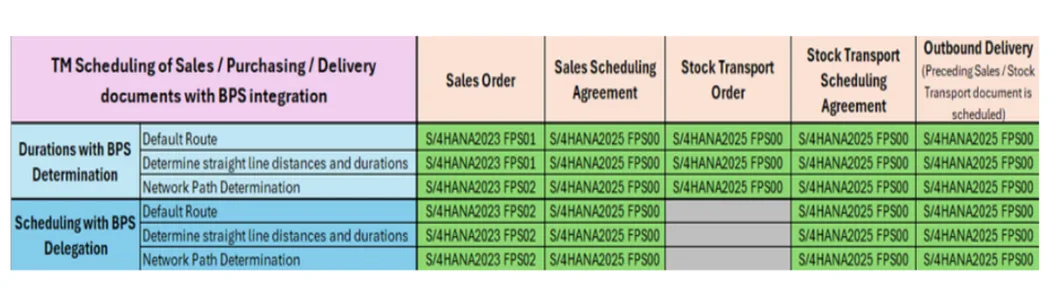
SAP resolved this gap with Business Process Scheduling (BPS) in SAP S/4HANA 2023 FPS1. BPS enables sales order scheduling to leverage TM’s transportation network and heuristics directly, ensuring aligned delivery dates across SD and TM and eliminating duplicate master data maintenance.
With S/4HANA 2025 FPS00, SAP is extending this capability further to support Stock Transport Orders, Sales Scheduling Agreements, Stock Transport Scheduling Agreements, and Outbound Deliveries. This expansion allows TM scheduling to be used across a wider range of logistics and order fulfilment scenarios, ensuring better alignment between transportation planning and overall business processes.
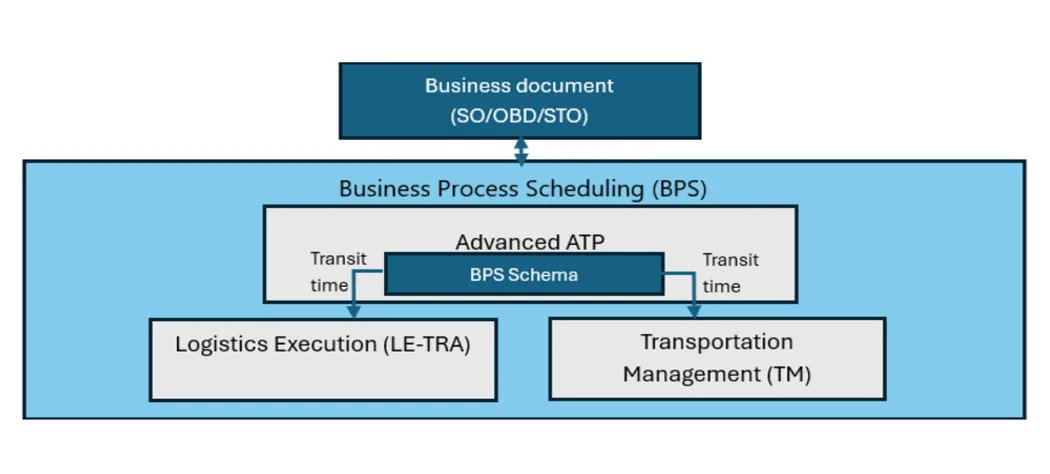
With S/4 HANA 2022, SAP introduced a new scheduling framework -Business process scheduling (BPS), a flexible configurable scheduling solution in advanced Available-to-Promise (aATP), that you can use within different business documents to schedule standard and custom logistical activities. Scheduled dates (and optionally, times) are returned to the respective business document (example Sales Order/Stock transport /Outbound delivery documents).
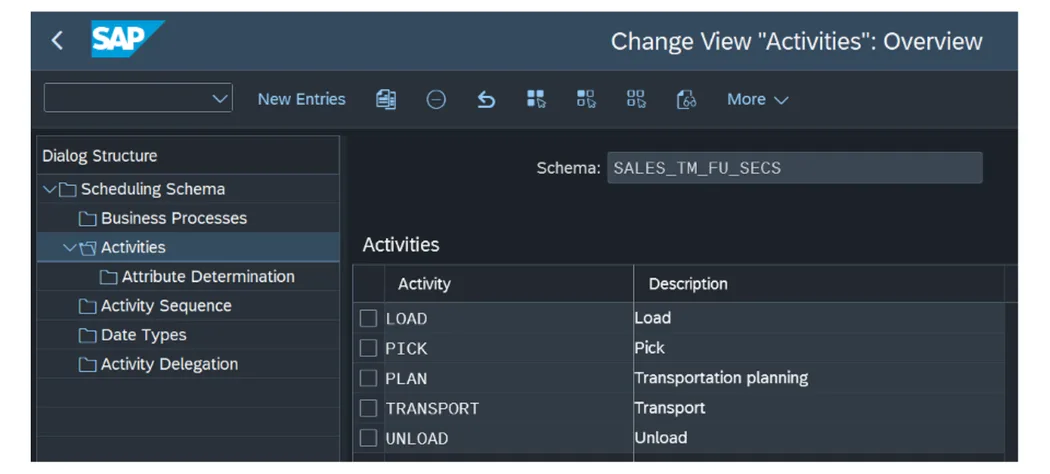
SAP delivers the BPS framework with a standardized BPS schema that serves as its structural foundation. This schema represents key logistics activities—such as transportation planning, picking, loading, transportation, and unloading—together with essential attributes including calendars, durations, and time zones. It also defines the activity sequence used to calculate individual durations and support end-to-end scheduling. SAP provides predefined BPS schemas for a set of standard scenarios.
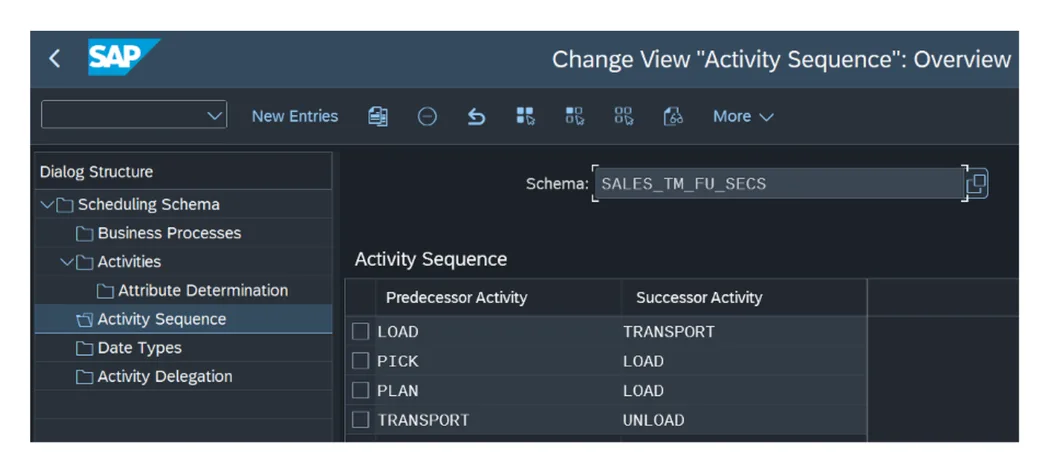
Transit times can be determined in two ways: either using route-based data from LE-TRA or by leveraging SAP Transportation Management (TM). Transit times derived from LE-TRA routing are relatively rigid and do not adequately support complex or dynamic transportation scenarios. TM overcomes this limitation by providing multiple options to calculate transportation distances and durations. These options are based on different objects—such as straight-line distances, default routes, transportation lanes, and schedules—allowing transit time calculation to be tailored to specific business scenarios and modes of transport.
The scheduling of a Sales Order uses the determination and delegation capabilities of BPS, which rely on Transportation Management (TM) for duration determination and scheduling logic. For most customers, sales order scheduling using master data and scheduling engine of TM in an embedded S/4 setup was one of the most desired functionalities and BPS meets this requirement. Depending on the required level of transportation detail and operational constraints, BPS offers two distinct integration approaches with Transportation Management.
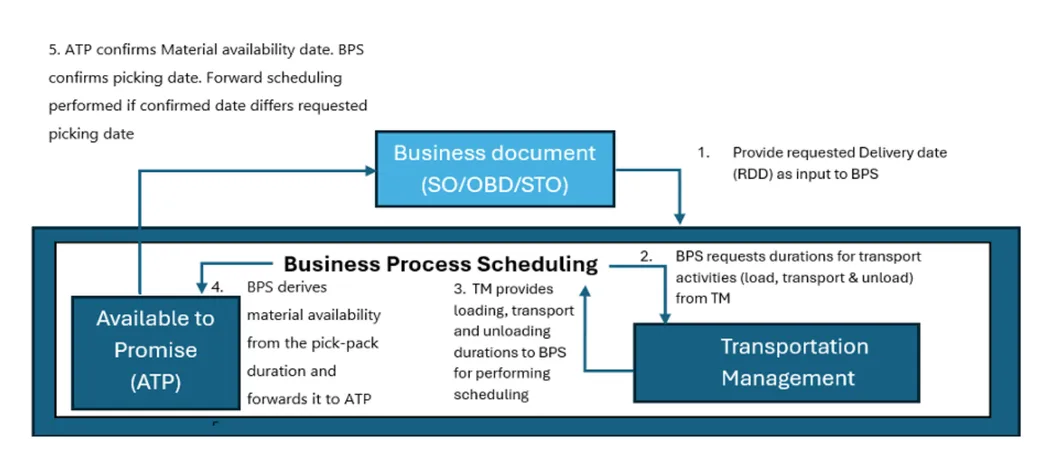
In SAP S/4HANA, when a sales order is created or updated, the system can leverage the BPS service to determine the key logistical dates involved in fulfilling that order. As part of this process, BPS requests duration information from Transportation Management (TM) for activities such as loading, transport, and unloading, using the routing methods defined in your Transportation Duration Determination profile. BPS scheduling takes the requested delivery date and material availability into account when estimating the delivery date. The result is a set of scheduled dates that feed back into the sales order, providing a more accurate delivery commitment based on the integrated TM data.
It is important to note that TM supplies duration values only and does not perform the actual scheduling. Since BPS treats transportation as a single activity, certain transportation-specific constraints cannot be fully reflected. For example, in scenarios involving multiple network stages, TM provides a consolidated transportation duration by summing individual legs, without accounting for operational details such as intermediate stop operating hours or waiting time for scheduled departures.
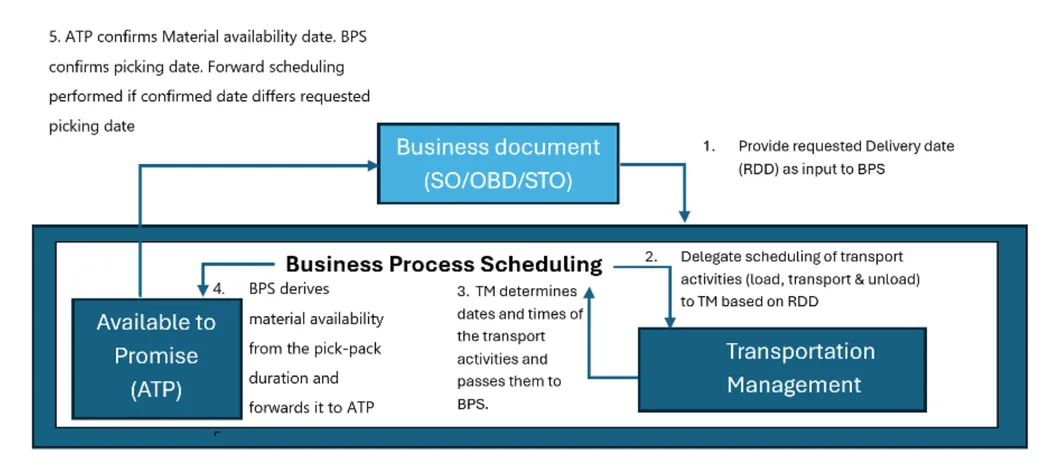
BPS delegates the scheduling of the loading, transport, and unloading activities to TM. As a result, TM delivers a date and time of delivery for each activity. Scheduling happens for the combination of the loading, transport, and unloading activities with embedded TM scheduling based on the Planning profile. Routing is performed based on the routing methods that you selected in your requirement routing profile. Scheduling in TM determines dates and times for loading, traveling, and unloading. Scheduling considers a reference date as requested delivery date in backward scheduling or as confirmed Loading start date in forward scheduling. Since scheduling takes place in TM, more information like operating times at intermediate stop, schedule departure waiting time, cargo cut off, availability time etc. can be incorporated into the scheduling results.
The evolution of order scheduling in SAP S/4HANA reflects SAP’s broader effort to better align transportation planning with core order fulfillment processes. By enabling integration between Business Process Scheduling (BPS) and SAP Transportation Management, organizations can generate delivery commitments that more accurately reflect real transportation constraints and operational realities. As businesses increasingly depend on reliable delivery promises to meet customer expectations and coordinate supply chain activities, TM-based scheduling provides a more integrated and scalable approach to logistics planning within SAP S/4HANA. With extensive experience in SAP Transportation Management and logistics transformation initiatives, ArchLynk helps organizations evaluate and implement these capabilities to improve delivery reliability and operational efficiency.
This blog provides an introductory overview of the evolution of order scheduling and the role of BPS in enabling TM-based scheduling. In upcoming blogs in this series, we will explore each TM-based scheduling approach in greater detail, including configuration considerations, execution flows, and practical implementation scenarios.
To learn more about how SAP TM scheduling can improve delivery commitment accuracy in SAP S/4HANA, connect with an ArchLynk expert.
References
Fig 2: Michael Haase — "TM Scheduling of Sales, Purchasing & Delivery Documents with BPS Integration", SAP Community.
https://community.sap.com/t5/supply-chain-management-blog-posts-by-sap/tm-scheduling-of-sales-purchasing-delivery-documents-with-bps-integration/ba-p/14282002