


Every logistics team knows the pain: a truck arrives at the dock but the warehouse isn't ready. Or goods are staged and waiting, but the carrier is nowhere to be found. These gaps — between transport planning and warehouse execution — cost time, money, and customer trust.
SAP Advanced Shipping & Receiving (ASR) was built to close exactly that gap.
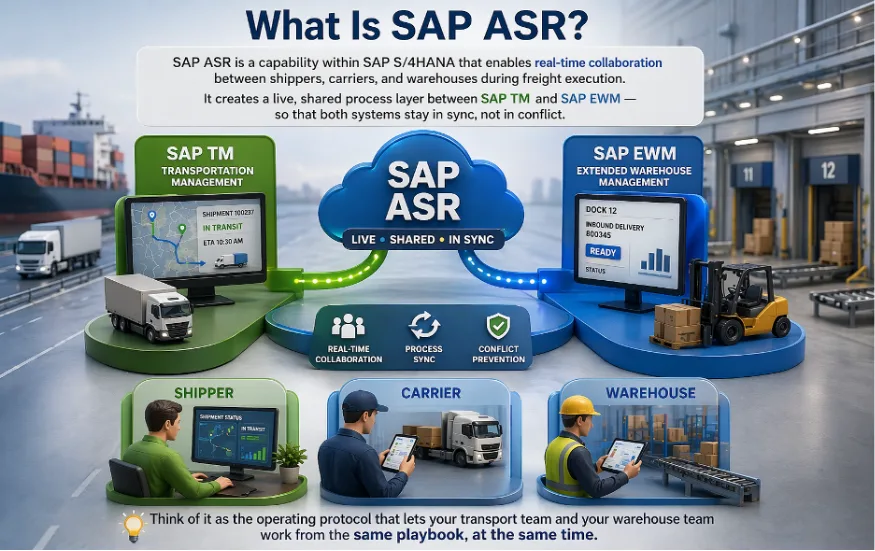
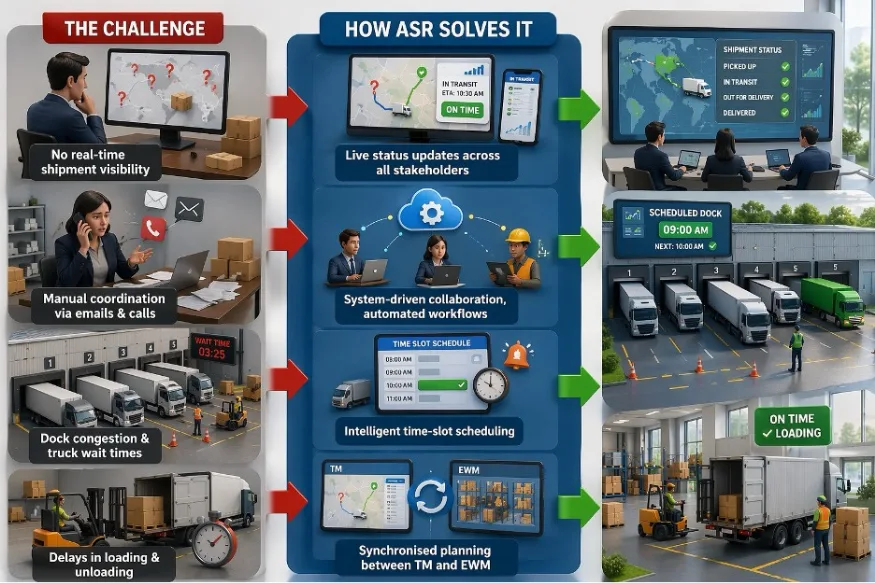
SAP ASR is a capability within SAP S/4HANA that enables real-time collaboration between shippers, carriers, and warehouses during freight execution. It creates a live, shared process layer between SAP TM and SAP EWM — so that both systems stay in sync, not in conflict.
Think of it as the operating protocol that lets your transport team and your warehouse team work from the same playbook, at the same time.
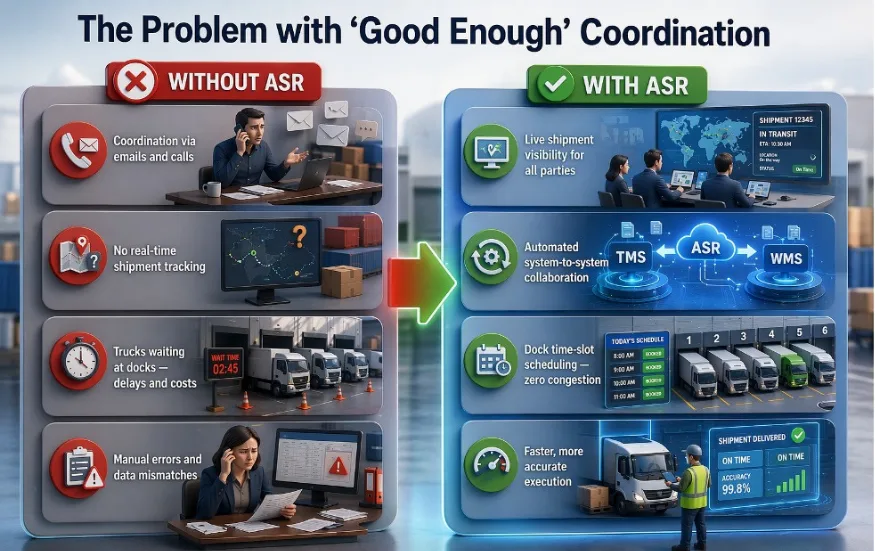
In traditional logistics setups, transport and warehouse teams operate independently. Communication happens through emails, phone calls, and spreadsheets. The result?
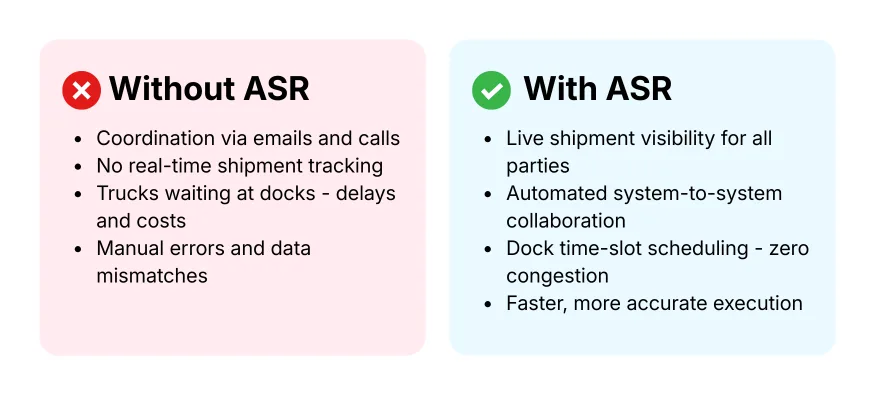
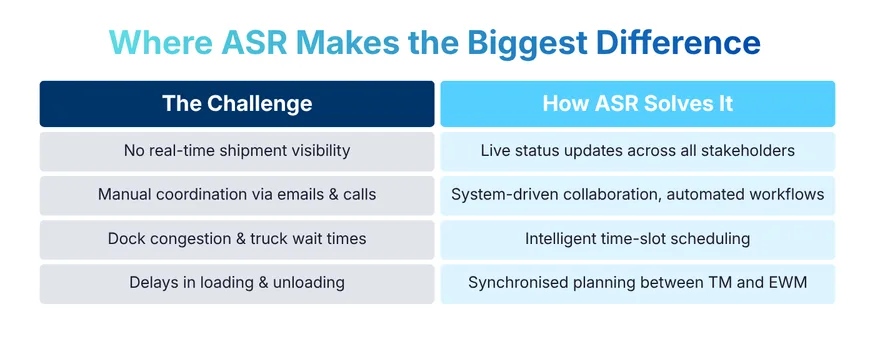
The business impact is straightforward: lower costs, faster deliveries, and a warehouse that talks to your transport team.
One of the most important design decisions in an ASR implementation is choosing who owns the process — Transportation Management or Extended Warehouse Management. This isn't a technical preference; it reflects how your business actually operates.
In a TM-driven setup, SAP TM is the decision-maker. The transport plan is created first: carriers are assigned, routes are defined, and schedules are locked. The warehouse then aligns its activities — picking, staging, loading — around that transport plan.
Best for:
Industries like FMCG and retail where on-time delivery and fixed carrier commitments define operational success.
In an EWM-driven setup, the warehouse calls the shots. Goods are picked, packed, and made ready first — and transportation is arranged around warehouse readiness. Dock scheduling and timing are controlled from within EWM.
Best for:
Manufacturing environments where production variability is high and warehouse readiness determines when transport can be scheduled.
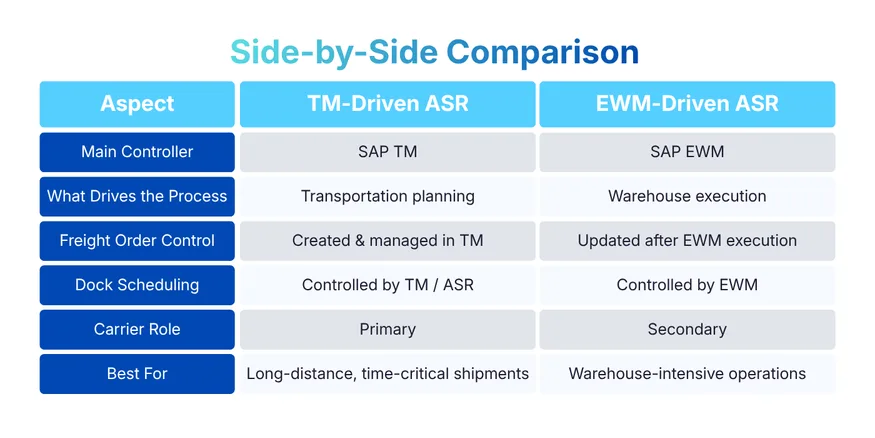
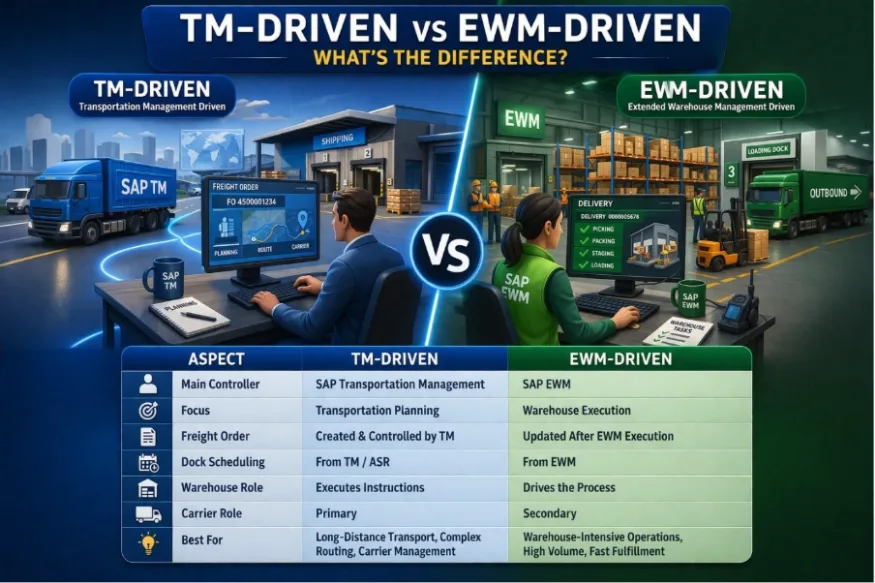
Many organisations don't have to choose one model exclusively. A common pattern is to use TM-driven ASR for outbound shipments (where delivery deadlines matter most) and EWM-driven ASR for inbound processes (where goods receipt triggers the next workflow). This hybrid approach delivers both delivery reliability and operational flexibility
ASR adoption isn't just a technology trend — it reflects a fundamental shift in how organisations think about logistics. Three forces are driving this change:
1. The End of Siloed Systems
Traditionally, SAP TM and SAP EWM operated independently, with heavy data duplication and manual hand-offs between teams. ASR changes that by creating a single, synchronised process layer — giving both teams end-to-end visibility without the friction of constant manual coordination.
2. S/4HANA Migrations as a Catalyst
As organisations move from ECC to S/4HANA, many are using the opportunity to rethink their logistics architecture from the ground up. Rather than simply replicating legacy TM-EWM integrations, progressive companies are adopting ASR as their modern integration standard — replacing outdated Transport Unit-based approaches with streamlined, intelligent workflows.
3. Smart Warehouses Demand Real-Time Sync
Robotics, Automated Guided Vehicles (AGVs), and AI-driven planning are transforming warehouses into smart facilities. In these environments, even a small misalignment between transport and warehouse can cascade into significant disruption. ASR provides the real-time synchronisation that modern, automated operations depend on.
The short answer: if you run SAP TM and SAP EWM together, and your teams are still coordinating manually, ASR is worth serious consideration.
Here's a quick way to think about your fit:
If you answered yes to more than one of these, ASR isn't just a nice-to-have — it's a strategic enabler.
ASR is more than a system upgrade. It's a shift in how your logistics operation is designed — moving from reactive coordination to proactive synchronisation. When implemented with the right model (TM-driven, EWM-driven, or hybrid), it delivers measurable improvements in cost, speed, and operational resilience.
ArchLynk helps organizations make this shift successfully by bringing deep SAP TM, EWM, and supply chain execution expertise — from ASR strategy and solution design to implementation and optimization. With the right partner, ASR can become more than an integration capability; it can become a real driver of logistics efficiency, visibility, and resilience. Connect with an ArchLynk expert to explore how SAP ASR can help your transportation and warehouse teams work smarter, faster, and in real time.