Microsoft Teams
Archlynk
  • Supply Chain Planning & Execution

    Agile Supply Chain

    SAP Integrated Business Planning

    SAP Transportation Management

    SAP Extended Warehouse Management

    SAP Business Networks for Logistics

  • Global Trade Services

    SAP Global Trade Services

    SAP S/4HANA for International Trade

  • Time-to-Value Solutions
  • Accelerators & Innovations

    Parcel Shipping Accelerator

    p44 Visibility Accelerator

    Loadsmart Freight Network Accelerator

    Supply Chain Portal

    Last-Mile Suite

  • Resources

    Insights

    Blog

  • About Us

    About ArchLynk

    Leadership

    Careers

    Partners

    News & Events

    Contact Us

  • Home
  • > Blog
  • > SAP GTS 2025 FPS01: Enhanced Country of Origin Determination Explained

SAP GTS 2025 FPS01: Enhanced Country of Origin Determination Explained

Thought Leadership 05/13/2026

Share post:

share share share dots
Copied!

SAP has released a new Feature Pack (FPS01) for SAP Global Trade Services 2025, bringing targeted innovations across several compliance domains. One of the most impactful updates in this release is the enhancement of Country/Region of Origin (CoO) determination, a key capability for companies managing complex international supply chains.

In this blog post, we take a closer look at what’s new in Origin of Goods management, why it matters from a compliance and operations perspective, and how organizations can benefit from the new functionality.

Why Country of Origin Determination Matters

Determining the correct non-preferential Country of Origin is a foundational requirement in global trade. It directly impacts:

  • Customs valuation and duty calculation
  • Trade statistics and reporting
  • Sanctions, embargoes, and trade defense compliance
  • Downstream processes such as preference determination and customs declarations

Historically, maintaining accurate origin information (especially for externally procured products and batch-managed materials) has been operationally challenging and often lacked transparency.

What’s New in SAP GTS 2025 FPS01 for Origin of Goods

With FPS01, SAP introduces a more structured and integrated way to manage and determine the Country/Region of Origin for procured goods, covering both product- and batch-level scenarios.

Key Value Proposition

The enhanced Origin of Goods feature enables organizations to:

  • Manage non-preferential country and region of origin for externally procured products and batches
  • Increase transparency by identifying the origin at the goods receipt level
  • Seamlessly integrate origin data with Preference Management and Customs Management
  • Automatically update origin data back to the connected feeder system (e.g., SAP S/4HANA)

This significantly reduces manual work and improves data consistency across systems.

Core Capabilities at a Glance

The new CoO determination functionality includes:

  • Automatic assignment of country/region of origin
    Based on available data in import customs declarations, Inbound LTSDs, or inbound deliveries
  • Manual override when required
    Allowing specialists to adjust origin data where business or legal justification exists
  • Product and batch master updates
    Origin information can be written back to the product or batch master in the feeder system
  • Support for batch-managed and non-batch-managed products
    With dedicated determination flows for both scenarios

Together, these capabilities provide a robust and auditable origin determination process aligned with regulatory expectations.
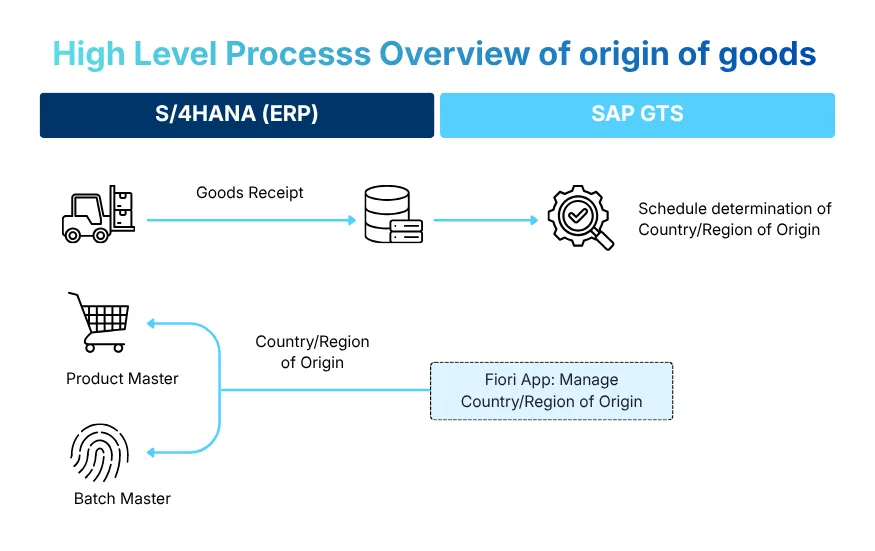
High-Level Process Overview

At a high level, the process works as follows:

  1. Goods are received, and relevant logistics or customs documents become available
  2. SAP GTS evaluates available country/region information
  3. The system determines the non-preferential origin
  4. Origin data is stored in GTS and synchronized with the feeder system
  5. The information becomes reusable for preferences, customs, and reporting processes

This end-to-end flow ensures origin data is determined once, maintained centrally, and reused consistently.

Why This Matters for SAP GTS Customers

For companies operating in highly regulated environments, this update delivers tangible benefits:

  • Better compliance through increased origin transparency
  • Reduced manual maintenance and error risk
  • Stronger integration between logistics, customs, and preference processes
  • Improved readiness for audits and regulatory reviews

In practice, this means fewer surprises at customs and more confidence in trade compliance decisions.

How ArchLynk Can Help

At ArchLynk, we help global organizations design, implement, and optimize SAP GTS solutions that align with both regulatory requirements and real-world business processes.

Whether you are:

  • Upgrading to SAP GTS 2025
  • Assessing the impact of FPS01
  • Looking to improve your Country of Origin determination and governance

Our experts can help you translate new SAP functionality into measurable business value. Want to understand how the new FPS01 functionalities can impact your business? Get in touch with us for a deeper insight.
Previous Post Next Post
ArchLynk
Contact Us
Services
Supply Chain & Global Trade Consulting Application Management Services SAP S/4HANA Cloud SAP Advanced Planning and Optimization
SAP S/4HANA Migration SAP Analytics Cloud SAP Yard Logistics SAP Business Technology Platform
Innovations
AI & ML (SAP TM + ShipEngine) Parcel Shipping Accelerator (SAP TM + Loadsmart) Freight Network Accelerator Carbon Management Solution ChatBots Tendering Award App
API & Middleware (SAP TM + p44) Visibility Accelerator Shipment Execution App Instant TM Carrier Ranking Report
About Us
Leadership Team Our Customers Locations
Careers (We're hiring!)
Contact Us
+1-866-960-9605

Privacy Policy Impressum / Legal Notice Cookie Preferences

© 2026 All rights reserved by ArchLynk