As global supply chains become increasingly complex and compliance requirements more stringent, companies are reevaluating their SAP landscape to ensure agility, transparency, and cost-efficiency. With the transition from SAP ECC to S/4HANA, many organizations are exploring whether the embedded international trade functionalities in S/4HANA can serve as a viable alternative to SAP Global Trade Services (GTS).
This blogpost provides a strategic overview of S/4HANA for International Trade, its capabilities, limitations, and integration potential. While SAP GTS remains the most comprehensive and mature solution for global trade compliance, S/4HANA offers embedded functionality that may be sufficient for certain business units or subsidiaries. We outline how ArchLynk supports clients in evaluating and implementing the right solution based on their specific needs.
International trade management is a strategic enabler of global business. From product classification and customs compliance to embargo checks and trade reporting, companies must ensure that their systems support regulatory adherence while minimizing operational friction.
SAP GTS has long been the gold standard for comprehensive trade compliance, offering deep functionality across customs management, preference processing, legal control, and SPL screening. However, its scope and licensing model may not be necessary for every part of an organization. S/4HANA introduces native international trade capabilities that promise tighter integration, simplified architecture, and reduced overhead—raising the question: when is S/4HANA enough, and when is GTS still essential?
Product Classification
S/4HANA enables classification of products under various nomenclatures such as the Combined Nomenclature (CN) for statistical reporting and control classes for trade compliance. The system introduces a new technical architecture using “numbering schemes” and “numbering scheme content,” allowing flexible sourcing of classification data—whether manually maintained, imported from SAP GTS, or provided by a external content provider.
For SAP GTS, a multitude of content providers offer automated updates for tariff and control lists.
Intrastat Reporting
Intrastat reporting is deeply integrated into S/4HANA’s enterprise management modules. The system extracts relevant data from purchasing, billing, and delivery documents, supplemented by master data and default values. The reporting process is streamlined through Fiori apps, enabling users to manage declarations, schedule data extraction jobs, and generate XML files for submission to national statistical authorities.
We are frequently asked whether Intrastat reporting should be handled in S/4HANA or SAP GTS. We can highlight that this decision depends on your business context and factors such as:
SAP GTS offers centralized reporting across multiple systems, while S/4HANA may be more suitable when reporting is closely tied to financial processes. We invite you to schedule a session with our experts to discuss your specific business context and determine the most suitable approach.
Trade Compliance
Trade compliance in S/4HANA encompasses legal control (import/export license management), embargo checks, and optional integration with SAP Watch List Screening. Unlike ECC’s SD Foreign Trade module, S/4HANA introduces a separate “trade compliance document” that acts as a shadow record for compliance checks, ensuring technical separation while maintaining business transparency.
Integration with SAP GTS and Watch List Screening
S/4HANA can serve as a feeder system to SAP GTS, with integration mechanisms similar to ECC. This allows organizations to maintain centralized compliance in GTS while leveraging S/4HANA’s embedded capabilities for local operations. Additionally, S/4HANA supports integration with SAP Watch List Screening via the Business Technology Platform (BTP), although this requires a separate license and content subscription.
SAP Watch List Screening: Licensing, Content, and Comparison with SAP GTS
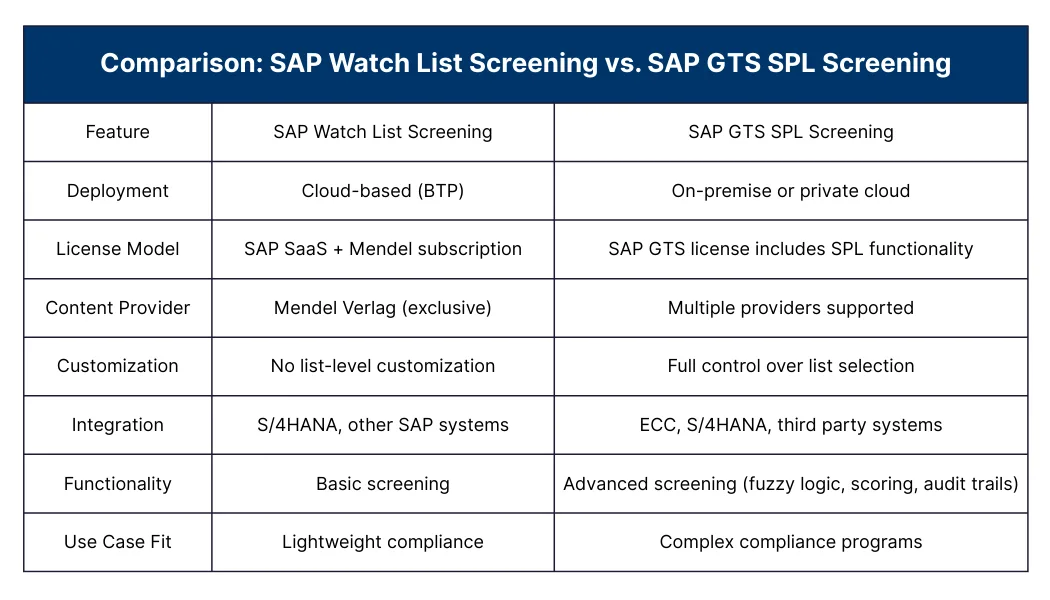
SAP Watch List Screening is a cloud-based service offered via the SAP Business Technology Platform (BTP). It enables companies to screen business partners—names and addresses—against sanctioned party lists (SPLs) to ensure compliance with international trade regulations. While it integrates with S/4HANA for International Trade, it is not part of the standard S/4HANA license.
Licensing Model
The licensing for SAP Watch List Screening consists of two distinct components:
1. SAP Cloud Service License: This covers technical access to the Watch List Screening functionality. It is sold as a Software-as-a-Service (SaaS) product.
2. Content Subscription via Mendel Verlag: Mendel Verlag, a German publishing house, is the exclusive content provider for SAP Watch List Screening. Customers must separately contract with Mendel to access SPL content. Mendel offers three predefined subscription packages:
Importantly, customers do not have the flexibility to select individual SPL lists. Instead, they must choose one of Mendel’s predefined packages. The contents of each package are determined solely by Mendel Verlag and cannot be customized. This content subscription represents an additional cost on top of the SAP cloud service license.
Implementing S/4HANA for International Trade requires careful planning. Key considerations include:
The architecture is modular and time-dependent, allowing for future-proof classification and compliance management.
Our Expertise: Guiding Clients Through the Transition
As a specialized SAP supply chain consulting firm, we bring deep expertise in both SAP GTS and S/4HANA implementations. Our consultants help clients:
Whether you're migrating from ECC or starting fresh with S/4HANA, we ensure your international trade setup is compliant, scalable, and cost-effective.
SAP GTS remains the leading solution for international trade compliance, offering unmatched depth and flexibility. However, S/4HANA for International Trade presents a compelling alternative for organizations seeking embedded functionality, simplified architecture, and cost-effective compliance for specific business units.
As trade regulations evolve and SAP continues to enhance its offerings, companies must stay informed and agile. We invite you to connect with our team to explore how S/4HANA and SAP GTS can support your international trade strategy—individually or in combination.