


With the evolution of SAP Joule, SAP’s AI copilot embedded across SAP applications, organizations now have two powerful extensibility concepts to leverage:
While they both extend Joule’s capabilities, they serve fundamentally different purposes. Understanding the distinction is critical for designing the right AI architecture for your enterprise.
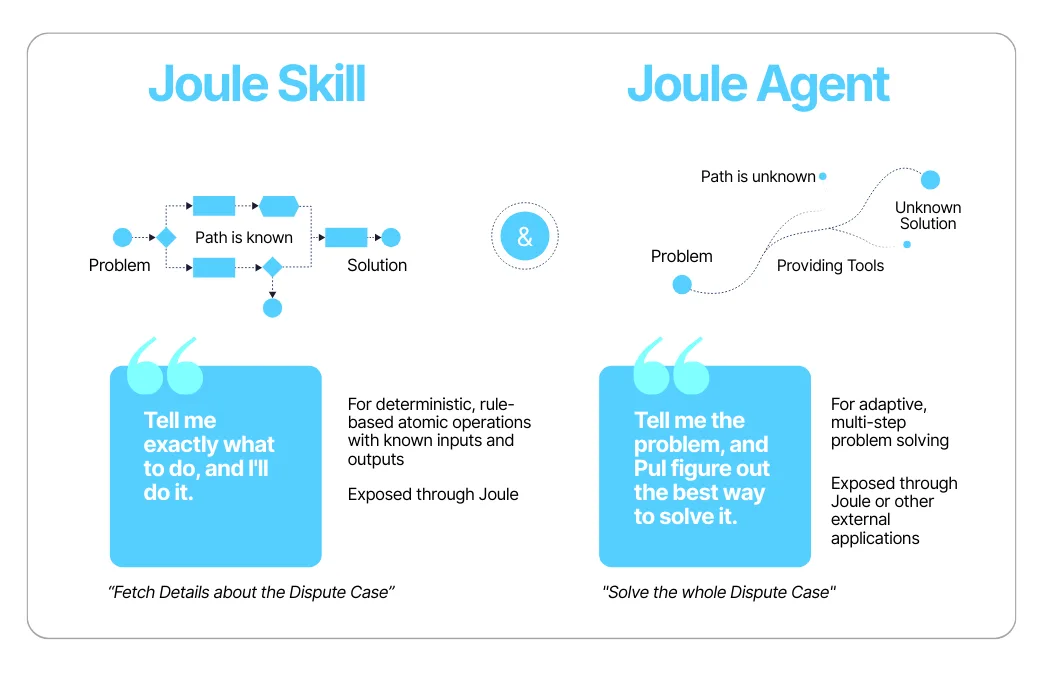
Let’s break it down.
Joule Skills are task-specific, deterministic capabilities that enable Joule to execute predefined actions in response to user prompts.
Think of Skills as:
“Structured functions that do one thing well — reliably and repeatedly.”
They are typically:
🔹 Key Characteristics
🔹 Examples
In short:
If the outcome is known and the path is defined → use a Skill.
Joule Agents represent the next level of enterprise AI inside Joule.
Unlike Skills, Agents are:
Instead of executing a single predefined action, Agents can:
Think of Agents as:
“AI colleagues that can reason, plan, and coordinate work.”
🔹 Key Characteristics
🔹 Examples
In short:
If the outcome is defined but the path is not → use an Agent.
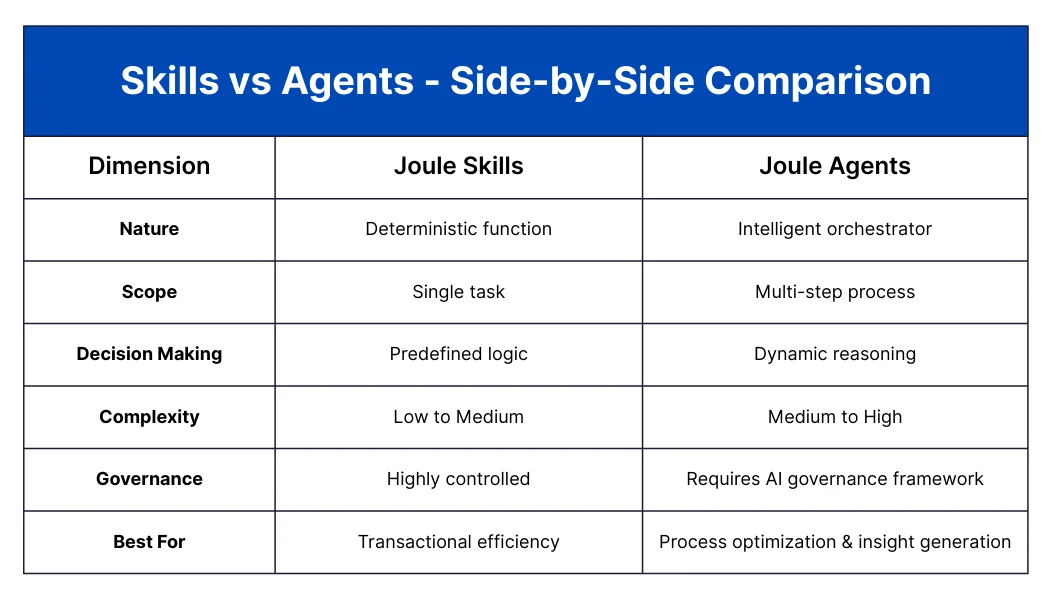
This is not an “either-or” decision.
In reality:
An Agent often calls multiple Skills behind the scenes. An Agent can call another Agent too!
For example:
User says:
“Help me prepare for this week’s carrier performance review.”
An Agent might:
This layered orchestration, combining deterministic Skills with AI-driven reasoning and summarization is what makes SAP Business AI enterprise-ready.
The difference between Joule Skills and Joule Agents is not about maturity — it’s about purpose.
As SAP continues embedding AI deeper into its ecosystem, understanding this distinction will be essential for architects, CIOs, and transformation leaders.
The competitive advantage will not come from deploying AI features alone, but from architecting them deliberately to fit your specific use case.
If you're exploring how to embed AI into your supply chain operating model, ArchLynk can help you design the right foundation.