


Enterprises have spent decades solving integration challenges across ERP, supply chain, and logistics systems. With the rise of AI and intelligent agents, that complexity hasn’t simplified — it’s exploded. Every system needs to connect to every tool. Every AI model needs access to multiple enterprise data sources. Every workflow requires custom orchestration logic.
Traditional integration approaches were designed for a world where humans orchestrated processes. In an agentic AI world, machines need to orchestrate themselves — and they need a shared language to do it.
Enter Model Context Protocol (MCP) — an open standard that enables AI applications to securely and seamlessly connect to external systems, tools, and data sources through a single, unified protocol. Think of it as the common plug for enterprise AI.
MCP introduces a structured, standardised model where three actors communicate through a single shared interface — Hosts (AI applications), Clients (integration connectors), and Servers (enterprise systems).
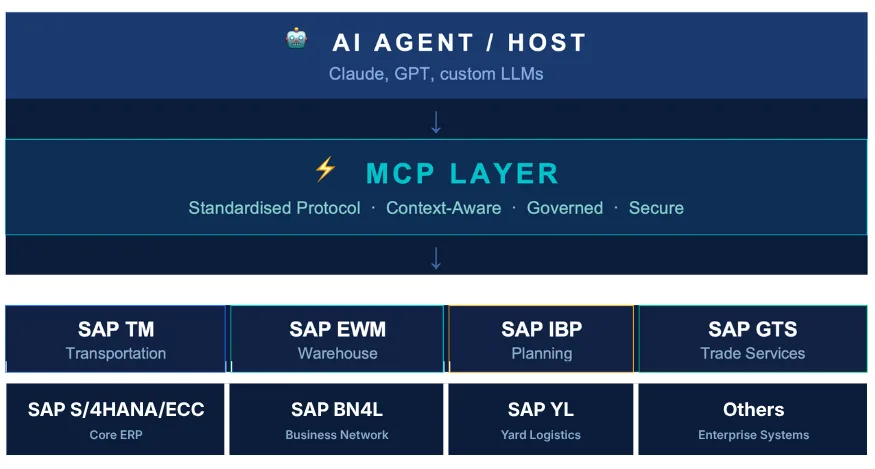
Rather than building bespoke connectors for every pairing of AI tool and enterprise system, MCP defines how all participants interact. Build each participant once; connect anything to anything.
01 — From Exponential to Linear Integration Complexity
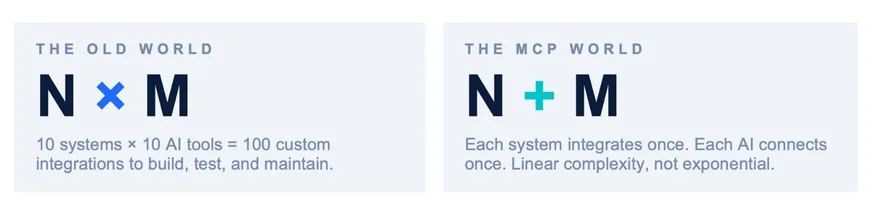
The N×M problem has quietly killed countless enterprise AI initiatives before launch. MCP collapses that to N+M, meaning your tenth system costs the same as your first to integrate, not ten times as much.
02 — From Prompt-Based AI to Protocol-Based AI
Older architectures embedded system instructions inside prompts; fragile, opaque, and difficult to audit. MCP replaces that with machine-readable structured interactions, separating AI reasoning cleanly from system execution.
03 — From Insight to Action — Real-Time
AI agents can now access live SAP and logistics data, trigger workflows, and execute end-to-end processes without replication layers or manual orchestration sitting in between.
04 — Governance Built In, Not Bolted On
MCP enforces controlled access, full auditability, and clear separation between AI reasoning and system execution, essential requirements for regulated environments like global trade and supply chain.
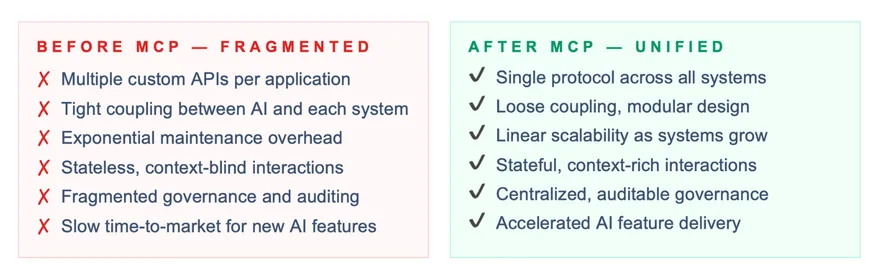
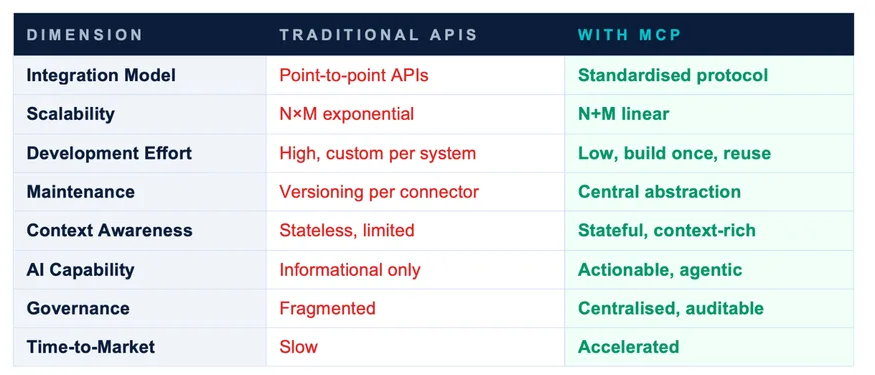
The shift from fragmented, point-to-point integration to a unified MCP layer translates directly to reduced development time, lower maintenance costs, and faster AI adoption.
Generic MCP servers provide a foundation. ArchLynk MCP is productised for real supply chain outcomes — with business semantics, pre-built intelligent actions, and end-to-end process orchestration embedded from day one.
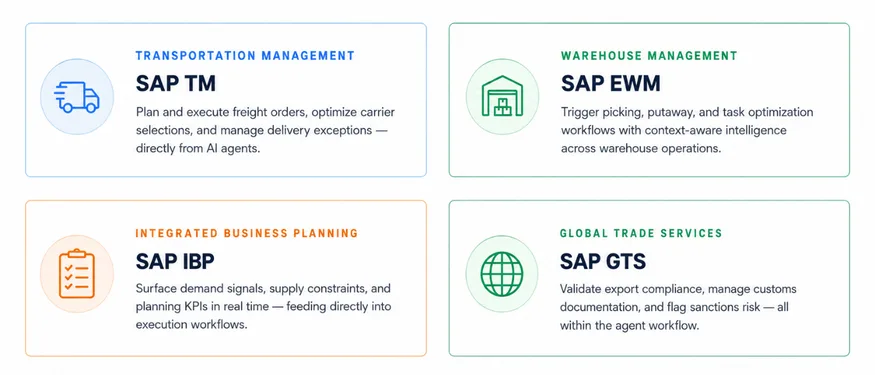
Consider a cross-border shipment that today requires a planner to manually check four systems. With ArchLynk MCP, a single AI agent completes the same workflow end-to-end.
1. SAP IBP
Retrieve Demand Plan
The AI agent queries IBP for the latest demand signals and confirmed orders, understanding supply constraints in context. It runs multi-echelon inventory optimisation, recommends safety stock, and simulates scenarios to flag capacity constraints before they bite.
ArchLynk agents: Demand Forecast · Supply Planning · Inventory Optimization · S&OP Insights
2. SAP TM
Create Optimised Freight Order
Based on demand data, the agent creates and optimises a freight order — selecting carriers, routes, and service levels automatically. It scores carrier performance, predicts freight cost and delays, and recommends proactive rebooking the moment a disruption emerges.
ArchLynk agents: Transportation Planning · Freight Audit · Track & Trace
3. SAP EWM
Trigger Warehouse Picking
Warehouse tasks are generated and sequenced in EWM, with real-time visibility into task completion status. Dynamic slotting and automated resource allocation balance labour and throughput, while outbound processing confirms orders without manual touch.
ArchLynk agents: Warehouse Operations
4. SAP GTS
Validate Export Compliance
Before goods leave the facility, the agent validates export licences, screens against sanctions lists, and prepares customs documentation. It classifies products to HS/ECCN codes, tests free-trade-agreement qualification, and monitors regulatory-change and shipment-hold risk in real time.
ArchLynk agents: AI Product Classification · Sanctions Screening · Customs Filing · FTA Qualification
5. ACROSS TM · EWM · GTS
Monitor & Resolve in Real Time
Once the shipment is moving, the agent tracks it end-to-end, issuing proactive ETA and disruption alerts, auto-resolving exceptions, and reconciling carrier invoices to recover overcharges, all without a planner watching screens.
ArchLynk agents: Track & Trace · Freight Audit
Result: End-to-end shipment execution; automated, governed, and real-time. What took a planner hours of system-hopping now completes in minutes with a full audit trail.
As enterprises move from AI experimentation to AI-driven operations, the biggest bottleneck isn’t the models themselves, it’s integration. MCP solves this by standardising integration, simplifying architecture, and enabling truly intelligent automation.
With ArchLynk MCP purpose-built for TM, EWM, IBP, and GTS, organisations can move from fragmented automation to connected, intelligent supply chains, at the speed the market demands.
Ready to connect your supply chain?
Talk to the ArchLynk team about MCP for TM, EWM, IBP, and GTS.