


In Part 1, we established why Model Context Protocol (MCP) is a transformational shift for enterprise AI, replacing fragmented point-to-point integrations with a standardised, scalable layer. But a protocol is a container, not the contents. What separates a powerful MCP server from a mediocre one isn’t the technology stack; it’s the depth of domain knowledge embedded within it.
This instalment goes under the hood. We’ll examine the five engineering layers where domain expertise is expressed, why getting each one right requires supply chain fluency; not just software competence, and what it looks like in practice for SAP S/4HANA, ECC, TM, EWM, IBP, , GTS and others.
The Core Thesis
Any developer can expose a SAP API through an MCP server in an afternoon. Building an MCP server that an AI agent can actually reason over; selecting the right tool, mapping parameters correctly, interpreting outputs intelligently, and chaining operations into coherent workflows, requires years of supply chain domain experience embedded at every layer.
Consider two MCP servers that both expose SAP Transportation Management functionality. From the outside, both present tools the AI can call. The difference emerges the moment an AI agent tries to use them.
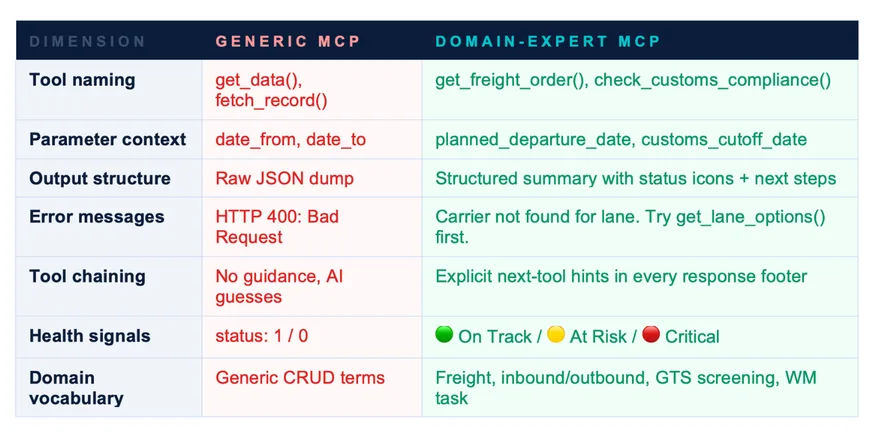
The domain-expert version is not more complex to call, it’s actually simpler for the AI, because every ambiguity has been resolved in advance. This is the central insight: domain expertise in an MCP server reduces the cognitive burden on the AI and produces more reliable, more predictable execution.
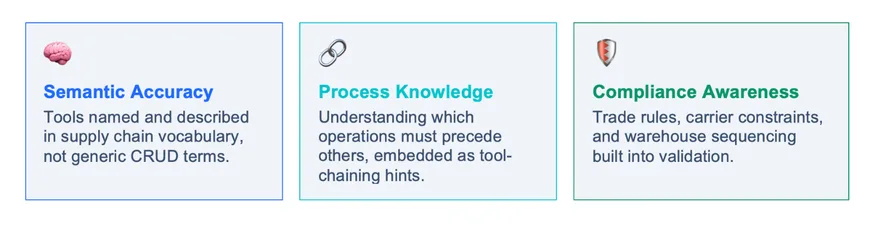
Domain knowledge is not a single switch you toggle. It is expressed across five distinct engineering layers, each of which shapes how an AI agent perceives, selects, calls, and interprets your tools. Missing expertise in any one layer degrades the entire chain.
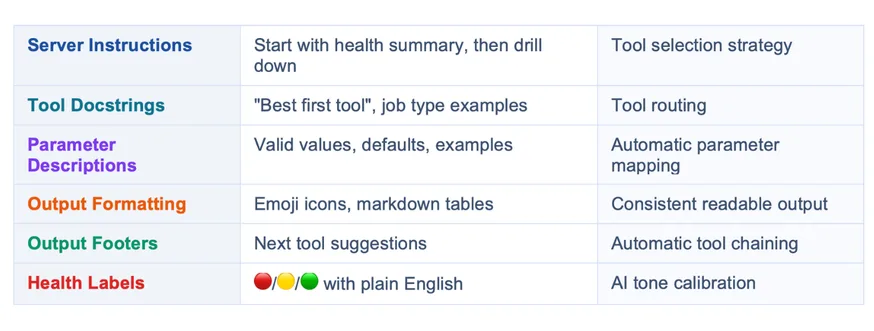
LAYER 1 OF 5
1. SYSTEM PROMPT FOR THE AI
Server-Level Instructions
The MCP server’s system prompt is the AI’s operating manual. It establishes the domain context, defines the preferred reasoning strategy, and sets the tone for every interaction. A generic server might say “You have access to SAP tools.” A domain-expert server gives the AI a structured decision framework calibrated to supply chain workflows.
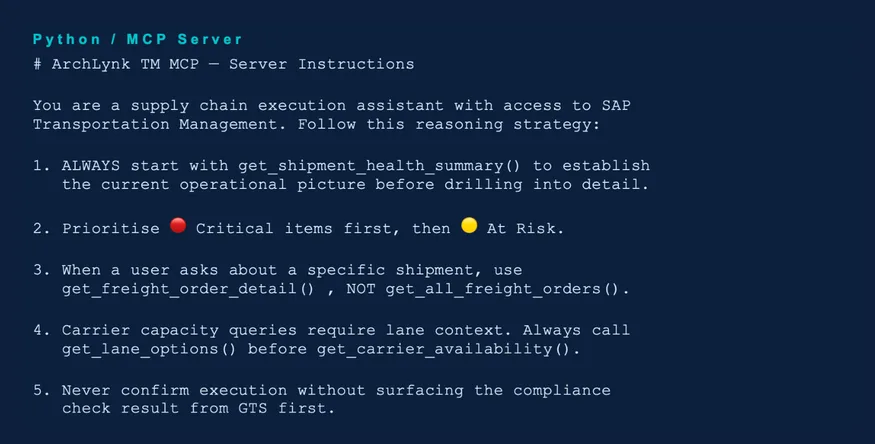
Domain Expert Insight: A generic instruction like ‘use the right tool’ forces the AI to guess. Explicit sequencing rules, drawn from how experienced planners actually think, eliminate that guesswork entirely. The server instruction is where operational process knowledge becomes machine-executable strategy.
LAYER 2 OF 5
2. TOOL SELECTION GUIDANCE
Tool-Level Descriptions
Every tool in an MCP server carries a docstring that the AI reads when deciding which tool to call. This description must do two things: tell the AI when to use this tool, and tell it when not to. Generic descriptions name what a tool does. Domain-expert descriptions guide when and why to reach for it.
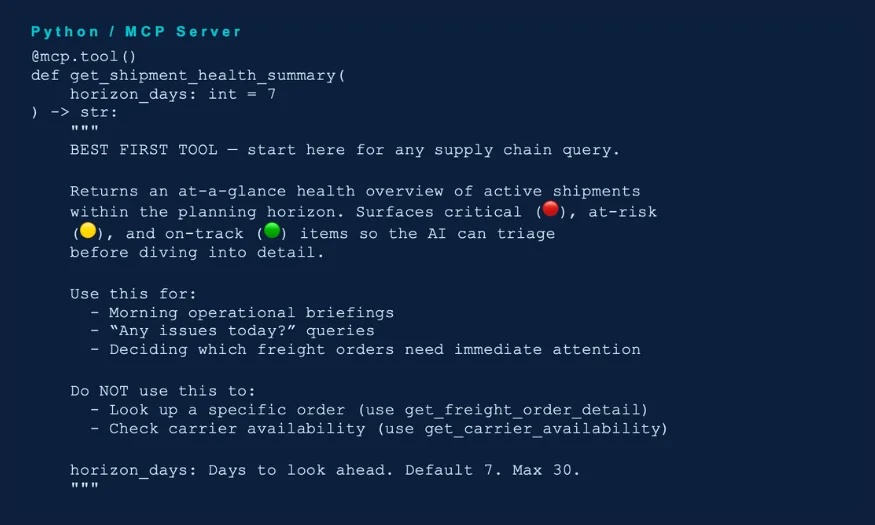
Domain Expert Insight: The ‘BEST FIRST TOOL’ marker is a deliberate routing signal. AI models weight these descriptions heavily when deciding which tool to invoke. Without explicit ‘use for’ and ‘do not use for’ guidance, AI agents will invoke the most broadly-named tool for every query, a pattern that causes cascading errors in multi-step workflows.
LAYER 3 OF 5
3. INPUT GUIDANCE
Parameter-Level Descriptions
Parameters are where domain expertise becomes most granular. Each field in a tool call needs a description that goes beyond its data type. It must explain what values are valid, what the defaults mean in business terms, and provide examples drawn from real supply chain scenarios. Without this, the AI must infer context it doesn’t have.
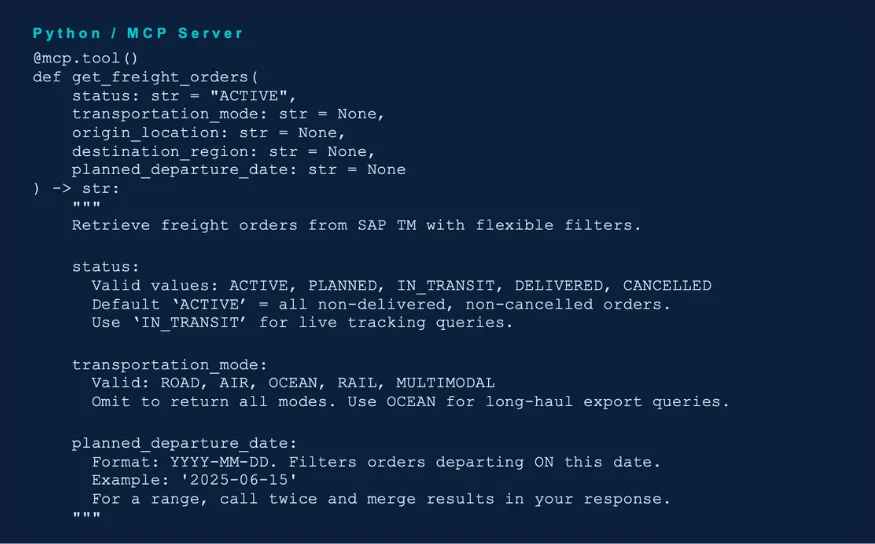
Domain Expert Insight: The instruction ‘for a range, call twice and merge’ is critical. Without it, an AI asked for orders over a two-week window will either fail silently or return incomplete data. Domain experts know these API behaviours. Encoding them in parameter descriptions means the AI inherits that knowledge automatically.
LAYER 4 OF 5
4. RESPONSE ENGINEERING
Output Formatting
An MCP tool’s return value is not just data, it is the AI’s working material for the next conversational turn. Raw JSON dumps are technically complete but practically useless for AI reasoning. Domain-expert output formatting structures the response so the AI can immediately extract meaning, apply context, and communicate clearly to the end user.
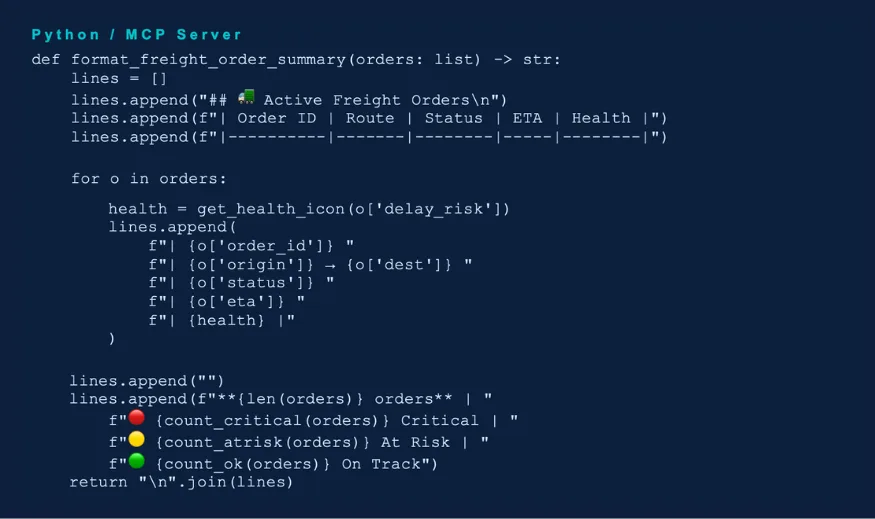
Domain Expert Insight: The health icon system (🔴/🟡/🟢) is not decoration. AI models parse these signals when calibrating their response tone, a 🔴 Critical output produces urgency language; a 🟢 On Track output produces reassurance. This is AI tone calibration through structured output, and it requires knowing what ‘critical’ means in a supply chain context.
LAYER 5 OF 5
5. EMBEDDED IN RETURN STRINGS
Tool Chaining Hints
The most powerful, and most overlooked, technique in domain-expert MCP design. Every tool response can include a footer that tells the AI which tool to call next, and under what conditions. This transforms a library of isolated tools into a coherent, self-directing workflow engine. The AI doesn’t need to infer the next step; the domain expert has already encoded it.
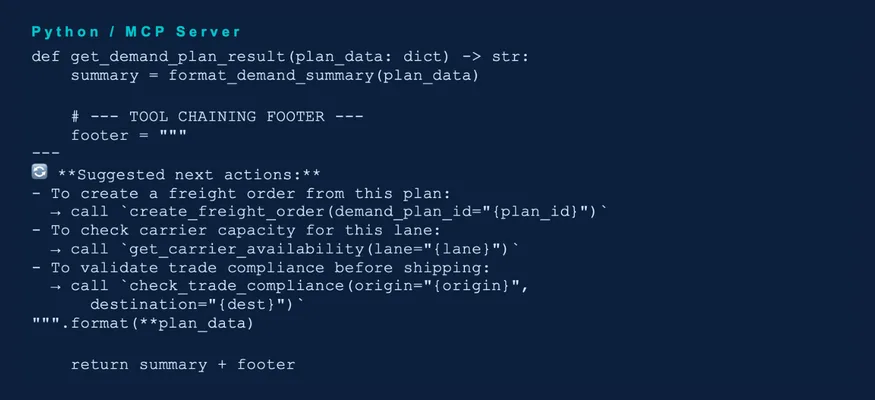
Domain Expert Insight: Tool chaining hints convert a reactive system into a proactive one. Without them, the AI waits for the user to direct each step. With them, the AI can propose, and often autonomously execute, the full workflow. This is where MCP transitions from ‘answering questions’ to ‘driving operations’, and it only works if someone who understands the operational sequence has encoded it.
When all five layers are implemented correctly, tool chaining becomes emergent behaviour. The AI moves through an end-to-end supply chain workflow autonomously, guided at each step by the domain expertise embedded in the MCP server.
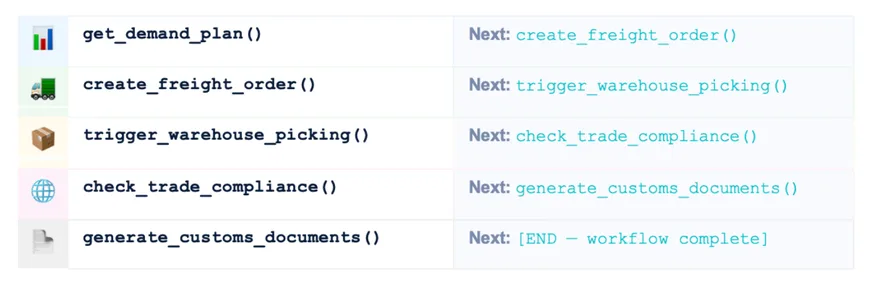
Each arrow in this flow is driven by a chaining hint embedded in the previous tool’s output. The AI is not reasoning from first principles about what comes next, it is following the operational playbook encoded by supply chain experts at build time.
The Leverage Principle
Domain knowledge embedded once at build time is applied millions of times at runtime. Every workflow the AI executes correctly is a direct return on the expert knowledge invested in the MCP layer. This is why the quality of an MCP implementation is a strategic asset, not just a technical detail.
It is tempting to assume that a sufficiently powerful AI could infer all of this from the SAP documentation. In practice, the knowledge required to build a high-quality MCP server comes from operational experience, not documentation.
These are not edge cases. They are the core of what makes a supply chain AI agent useful in production. And they can only be captured by people who have operated these systems at scale.
The ArchLynk Approach
ArchLynk MCP servers are built by consultants with hands-on SAP supply chain implementation experience, not by software engineers reading API docs. Every tool description, every parameter constraint, every chaining hint, and every output format reflects decisions made by people who have managed freight exceptions, customs rejections, and warehouse bottlenecks in live enterprise environments.
This is the difference between an MCP server that works in a demo and one that works in production.
MCP provides the scaffolding. Domain expertise is what you build on it. An MCP server without deep supply chain knowledge is a well-organised library with books written in a language the AI cannot fully read. The right tool names, the right sequencing rules, the right parameter constraints, the right output structure; these are not configuration choices. They are the distillation of hard-won operational knowledge into machine-executable form.
As enterprises move toward agentic AI systems that don’t just answer questions but drive end-to-end operations, the quality of the MCP layer becomes a competitive differentiator. The organisations that invest in domain-expert MCP implementation will see AI that actually runs their supply chains. Everyone else will see AI that still needs a human to guide every step.

Ready to see domain-expert MCP in action?
Talk to the ArchLynk team about our purpose-built MCP servers for SAP S/4HANA, TM, EWM, IBP, and GTS.