


Parts 1 and 2 of this series established what MCP is and why domain expertise is the decisive variable in MCP quality. This instalment addresses the question every SAP customer is now confronting: SAP has launched its own MCP capability inside Integration Suite, so do I still need to build my own?
The answer is not binary. But getting it wrong, in either direction, has real consequences for your AI strategy, your compliance posture, and your ability to deliver on the agentic AI promise in production.
This blog gives you the full picture: what SAP’s Integration Suite MCP Gateway actually does, where it falls short, how it compares to building a custom MCP server in VS Code with Claude, and how the two approaches can complement each other in a mature enterprise architecture.
A Critical Context: SAP’s New API Policy
In April 2026, SAP published API Policy v4/2026. Section §2.2.2 prohibits use of SAP APIs for “interaction or integration with (semi-)autonomous or generative AI systems that plan, select, or execute sequences of API calls”, except through SAP-endorsed architectures. Enforcement began June 9, 2026. This policy fundamentally changes the compliance calculus for any custom MCP implementation connecting to SAP systems.
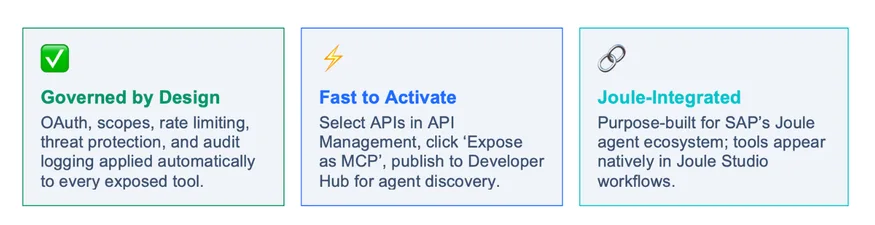
Announced at SAP TechEd 2025 and reaching general availability in Q2 2026, the MCP Gateway is a new capability within the API Management component of SAP Integration Suite. It allows organisations to expose their existing SAP and non-SAP APIs as governed MCP tools, without writing code.
SAP’s Architecture Center articulates a two-track MCP strategy. Internally, Joule uses MCP to access the SAP Knowledge Graph; enriched with full semantic context, ontologies, and business domain understanding. Externally, the Integration Suite MCP Gateway handles tool exposure for third-party agents and developers.
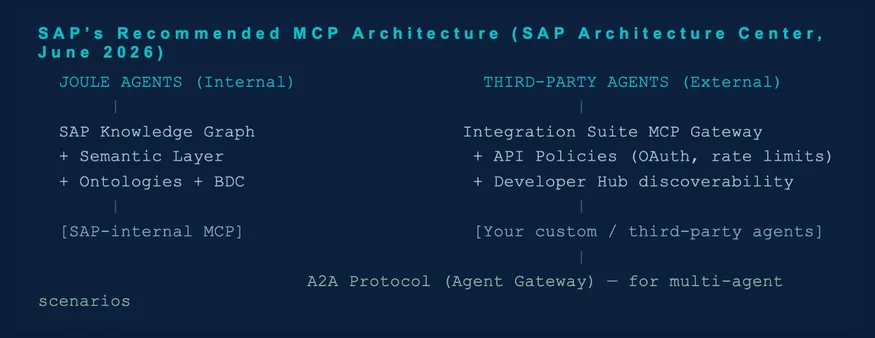
Key insight: As one SAP community expert observed, SAP effectively has two MCPs: one used internally by Joule (with full semantic grounding through the Knowledge Graph) and one available externally through Integration Suite. They are architecturally distinct. The external one is “MCP as just another protocol”, comparable to SFTP or REST, not the rich semantic layer Joule enjoys internally.
The Integration Suite MCP Gateway is a genuine and useful product, but understanding its current limitations is essential before committing it as the foundation of a production agentic AI strategy, particularly for complex supply chain scenarios.
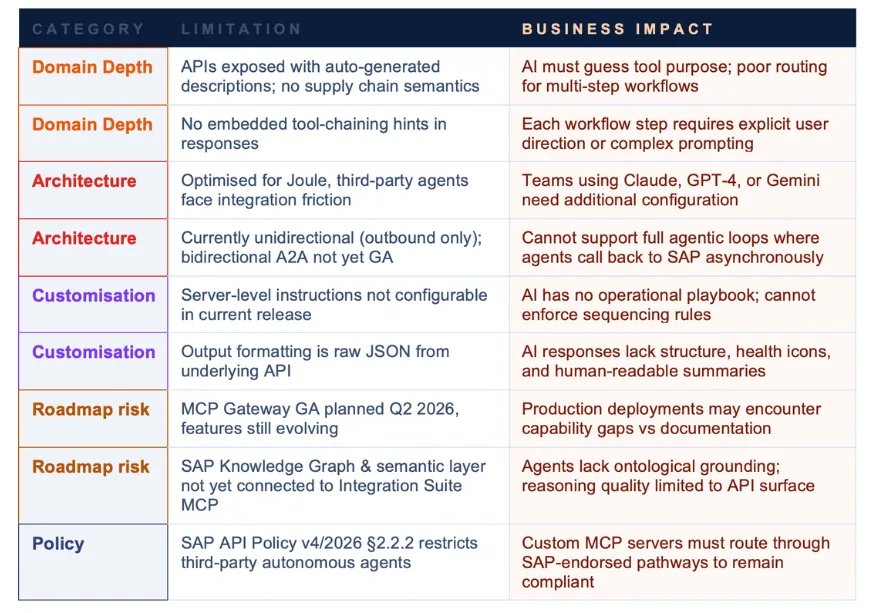
The Semantic Gap — SAP’s Own Acknowledgement
SAP’s own Architecture Center states: “Connecting an MCP server directly to raw SAP transactional APIs without semantic enrichment leads to poor entity discovery accuracy, excessive token consumption and, for write operations, a significant risk of incorrect business transactions.” This is not a third-party critique, it is SAP’s own engineering guidance, and it applies directly to what the Integration Suite MCP Gateway currently exposes.
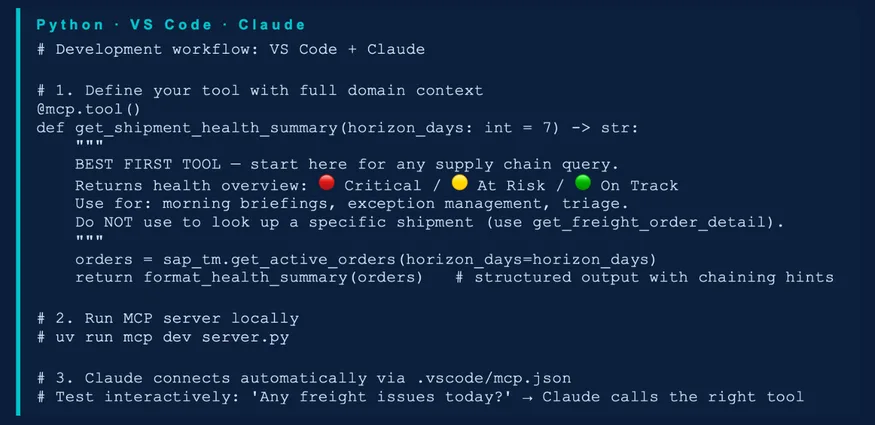
A custom MCP server built by domain experts, using Python or TypeScript, developed in VS Code and tested interactively with Claude is a fundamentally different artefact from what Integration Suite auto-generates. The difference is not tooling preference; it is architectural philosophy.
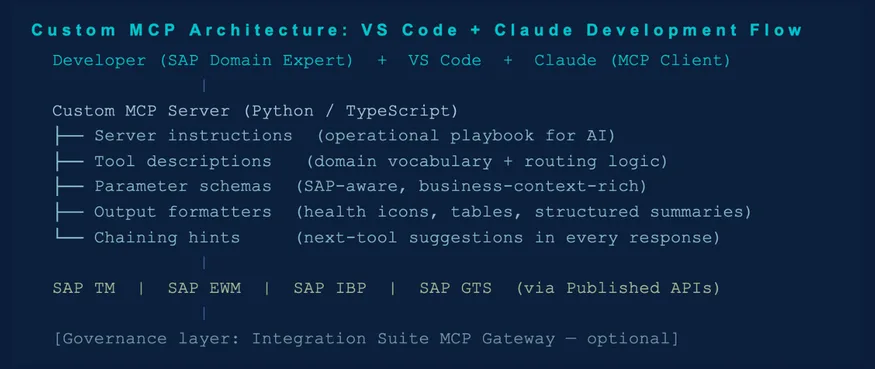
In VS Code, the developer writes the MCP server as normal code; Python being the most common choice. Claude Desktop or Claude Code acts as the MCP client during development, allowing the developer to interactively test every tool, refine descriptions, observe how Claude routes between tools, and iterate on output formatting in real time. The feedback loop is immediate.
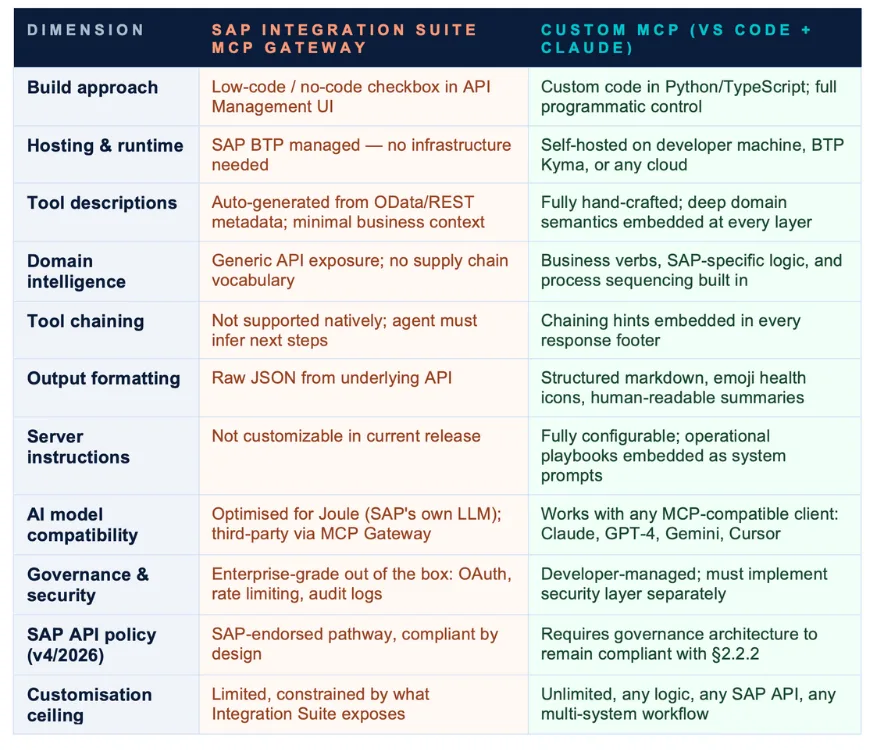
This table reflects the state of both approaches as of June 2026, based on SAP’s published architecture guidance, community analysis, and ArchLynk’s implementation experience.
The most consequential development for anyone building custom MCP servers against SAP systems in 2026 is not technical, it is legal. SAP’s updated API Policy (Section §2.2.2) restricts autonomous AI agents from calling SAP APIs outside SAP-endorsed pathways. Enforcement began June 9, 2026.
SAP API Policy v4/2026 — §2.2.2 (Exact Language)
“Except through and within the limits of SAP-endorsed architectures, data services, or service-specific pathways expressly identified and intended for such purposes, SAP prohibits API use for: (a) interaction or integration with (semi-)autonomous or generative AI systems that plan, select, or execute sequences of API calls, and (b) scraping, harvesting, or systematic and/or large-scale data extraction or replication.”
The ArchLynk Compliance Architecture
ArchLynk MCP servers are architected as a two-layer stack: a domain-expert MCP layer (custom, Python-based, supply chain semantics embedded) sitting above an Integration Suite governance layer that handles OAuth, rate limiting, and SAP API policy compliance. This gives clients the full depth of domain expertise without compromising their compliance posture.
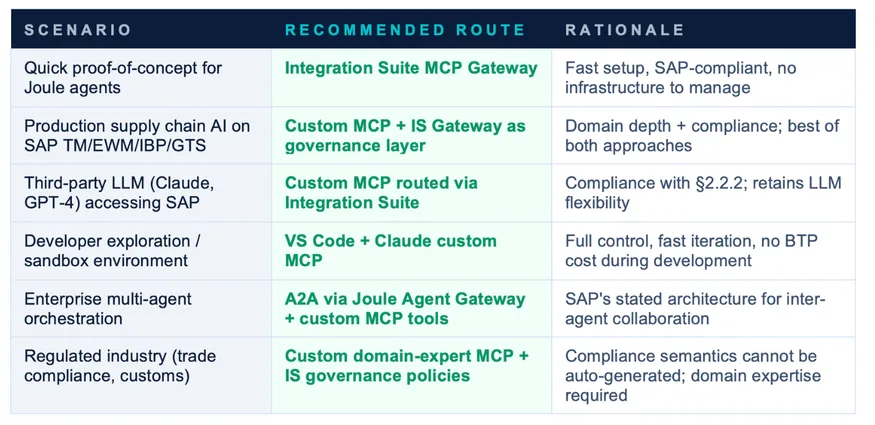
The choice between Integration Suite MCP Gateway and a custom-built domain-expert MCP server is not either/or. In most production scenarios, the answer is both — with Integration Suite providing the governance layer and custom MCP providing the intelligence layer.
The ArchLynk View
For organisations running SAP TM, EWM, IBP, and GTS — the answer is almost always a custom domain-expert MCP layer governed by Integration Suite. The IS Gateway provides the compliance and infrastructure envelope. The custom layer provides the supply chain intelligence. Neither alone is sufficient for production-grade agentic AI in a regulated supply chain environment.
SAP’s Integration Suite MCP Gateway is a meaningful step forward, it makes governed, compliant MCP exposure accessible to organisations that don’t have the engineering capacity or domain expertise to build their own. For many teams, it will be the right starting point and the right compliance layer.
But it is not a substitute for domain expertise. The SAP Knowledge Graph that powers Joule internally, with its ontologies, semantic enrichment, and business context, is not yet available through the external MCP Gateway. What the Gateway exposes today is SAP’s API surface, not SAP’s domain intelligence. That gap is real, and for complex supply chain workflows, it matters enormously.
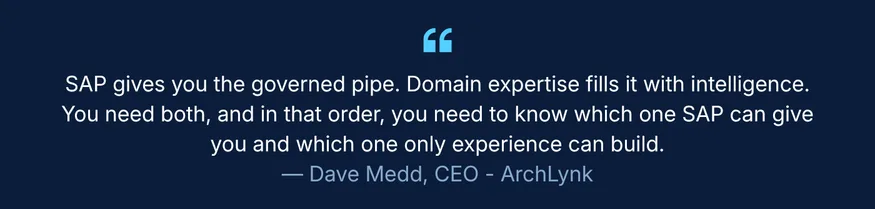
The organisations that will lead in agentic supply chain AI are those that combine both: the governance and compliance infrastructure SAP provides through Integration Suite, and the deep operational intelligence that only domain experts can embed into a custom MCP layer. That combination, not either approach alone, is what turns AI into execution.
Talk to ArchLynk about your MCP strategy
We help supply chain organisations navigate both Integration Suite governance and custom domain-expert MCP design — so you get compliance and intelligence, not a trade-off between them.